A popular post from April 2012
By Josi S. Kilpack
I've heard it said that metaphor cliches are victims of their own success, that because they are SO good at what they do, they are bad. Make's sense, right? Yeah, it took me a minute too, so I'm going to try my best to explain it.
A metaphor is the epitome of show don't tell or figurative writing--it is using words (which typically 'tell) to 'show' something, often combining something commonly understood to whatever it is the writer wants to describe. For example instead of saying bright yellow coat you say "sunshine yellow coat" or instead of saying excruciatingly thin you say "spaghetti-noodle thin." You're using the commonality of one thing to 'show' the details of something else. You are saying something IS something else--the coat IS yellow, the girl IS thin. Some more complex metaphors are things like "She was laughter and sunshine," or "the night is thick with hatred."
A simile is similar (ha, punny) to a metaphor except that it uses "like" or "as" within it's description. So it might be "As yellow as sunshine" or "thin like a spaghetti noodle". You get a similar 'show', but you use 'like' or 'as' to help you make the point. You are saying something is MUCH LIKE something else. They can get complex as well, for instance "She made me feel as light as laughter and as bright as sunshine" or "the feeling of hatred was as thick as peanut butter" Now, there are some exceptions to the 'like/as' factor of similes, but I'm not going to get into that because I don't really get it. For me, understanding that if I use "like" or "as" in a comparison description, it's a simile.
Both metaphors and similes are wonderful things in fiction--they allow us to manipulate words and make them into pictures. They make our stories visual, which means we're engaging multiple senses and the more senses you can engage, the more real your story feels. So, we shall all agree that metaphors and similes are wonderful things.
Now that we are in agreement, let us move on like a Vegas bride the morning after, shall we?
A metaphor cliche, then, is a really, really good metaphor or simile that people like so much they have used it to death and therefore we no longer even think about what it means. For example "rail thin" when you hear that, what do you think about? Do you actually think about the rail of a chair, which is where the description came from? No, you just think thin. How about "Icing on the cake", for me, I just think of a frosted cake. What it actually means is adding something good to something that's already wonderful, but it's used so often that we kind of skim over it which means we don't end up with the visual after all which then defeats the purpose of having used the metaphor or simile.
It can be very difficult to see our own metaphor cliches. Typically, this isn't something you worry about too much in your first draft, but when you go back to your revision, be sure to take the time to note the metaphors and similes you've used and make sure they are doing their job, instead of lounging in the back of the room flirting with your muse and resting on their laurels of overuse. They continue to work well in dialogue, however, because we talk in cliches all the time.
A fun thing to do when you do in fact encounter these cliches, is to think of ways you can re-invent them. For instance, instead of "Fog as thick as pea soup" consider "Fog as thick as milk left on the counter for three days" or "Fog as thick as pond scum" or "Fog as thick as Aunt Harriet's cold cream that hadn't worked as well as she'd hoped it would." Instead of "Thinking outside the box" you go with "Thinking outside the kiddie pool" or "Thinking outside the Congressional Hearing". Changing up a cliche is a fun play on the familiar and makes you look very clever.
So, in summary, we want our words to be OUR words, and we do that by holding them up to the light and looking at them from every angle until we are content to put our name on it and claim it as our own.
And, although this post is about metaphor cliches, there are all kinds of other cliches--word choices we don't even think of the meaning of. Many of them are peppered throughout this post, but since I was focusing on metaphor cliches, I'm going to let them slide, just this once. :-)
Happy Writing!
Friday, October 23, 2015

Monday, October 19, 2015
Important Tips for Self-Editing
A popular post from October 2012
by Annette Lyon
I taught a class on self-editing at UVU's annual Book Academy conference. When I first got the assignment, I wondered if I could fill a whole hour.
Then I started taking notes on common things I regularly see in my freelance work. Next thing I knew, I was cramming information into the workshop, and we still had more to cover when it ended.
Below are just a few tips from that class. I may give more in the future.
Be Specific
I've talked about specificity here before. (Read that post! It's a good one, if I say so myself.) But it's a topic that needs mentioning again, because it's something we writers easily forget.
When Lisa Mangum, a senior editor at Deseret Book (and great novelist) heard I was teaching the self-editing class, she told me to make sure to mention specificity. But she didn't use that term.
Instead, she called it "strong nouns and verbs."
(I'd add strong adjectives to that list, with the caution to use them sparingly. Think of Mr. Keating's lesson on tired versus exhausted.)
The stronger your nouns and verbs, the stronger your story will be. So the man didn't walk; he sauntered. The woman isn't driving a car; it's a Jeep. The path isn't lined with flowers, but with columbine.
Read the original post in the link above for a more detailed explanation and examples about specificity.
Cut the Dead Wood
This means repetitive words, ones that weak, or are in some other way unnecessary.
Here are a few examples of dead wood and how to trim it for crisp writing:
in order to = to
due to the fact that = because
a long period of time = a long time OR a long period
he nodded silently = he nodded (I dare you to nod loudly)
were going to = would
he knew that = he knew
all of the things = everything
the tragic drowning death =the tragic drowning (if someone drowns, we know they're dead)
her hair hung down = her hair hung (implies down)
she spoke with an impatient tone of voice = she spoke with an impatient tone (implies of voice) OR she spoke impatiently (But don't use too many adverbs. See below.)
they stood up = they stood
Sensory Duh Moments
This is another form of dead wood, one that's easy to overlook.
He nodded his head (as opposed to nodding his what, elbow?)
She blinked her eyes (as opposed to blinking her toe?)
And so on. I see this kind of dead wood with gestures, wiping tears, squinting, tasting, and more. If your character is using one of their five senses, great! Just don't be redundant in pointing out which one; we can figure it out.
Watch Your Adverbs
Here's another one Lisa asked me to mention, so take note of it.
Some people eschew all adverbs. I'm not in that camp. But I do believe that about 80% of the time, the narrative and dialog can and should do enough showing that we don't need an adverb for clarity. Look at your adverbs and ask yourself if there's a more powerful way to say the same thing without using them.
(Hint: Maybe you can use a stronger noun and/or a stronger verb.)
Last One for Today: Avoid Passive Voice
Yet another issue Lisa mentioned.
Contrary to popular belief, passive voice is not just any sentence with a word like was in it. A to-be verb (is, was, were, am, etc.) can signal passive voice, but not always. I've written about passive voice before as well, so if you're unsure what it is, go read that post.
One thing I'd add is that passive voice can be a great tool when it's intentionally used to obscure who did something or for a character to avoid blame. Before trying that, be sure you know what passive voice is and how to use it.
I'll delve into more self-editing tips another time. As always, don't panic about these things in the drafting stage. Let your muse carry you then. Later, when it's time to don the editing and revision cap, pull out your notes and apply these tips to strengthen your work.
by Annette Lyon
I taught a class on self-editing at UVU's annual Book Academy conference. When I first got the assignment, I wondered if I could fill a whole hour.
Then I started taking notes on common things I regularly see in my freelance work. Next thing I knew, I was cramming information into the workshop, and we still had more to cover when it ended.
Below are just a few tips from that class. I may give more in the future.
Be Specific
I've talked about specificity here before. (Read that post! It's a good one, if I say so myself.) But it's a topic that needs mentioning again, because it's something we writers easily forget.
When Lisa Mangum, a senior editor at Deseret Book (and great novelist) heard I was teaching the self-editing class, she told me to make sure to mention specificity. But she didn't use that term.
Instead, she called it "strong nouns and verbs."
(I'd add strong adjectives to that list, with the caution to use them sparingly. Think of Mr. Keating's lesson on tired versus exhausted.)
The stronger your nouns and verbs, the stronger your story will be. So the man didn't walk; he sauntered. The woman isn't driving a car; it's a Jeep. The path isn't lined with flowers, but with columbine.
Read the original post in the link above for a more detailed explanation and examples about specificity.
Cut the Dead Wood
This means repetitive words, ones that weak, or are in some other way unnecessary.
Here are a few examples of dead wood and how to trim it for crisp writing:
in order to = to
due to the fact that = because
a long period of time = a long time OR a long period
he nodded silently = he nodded (I dare you to nod loudly)
were going to = would
he knew that = he knew
all of the things = everything
the tragic drowning death =the tragic drowning (if someone drowns, we know they're dead)
her hair hung down = her hair hung (implies down)
she spoke with an impatient tone of voice = she spoke with an impatient tone (implies of voice) OR she spoke impatiently (But don't use too many adverbs. See below.)
they stood up = they stood
Sensory Duh Moments
This is another form of dead wood, one that's easy to overlook.
He nodded his head (as opposed to nodding his what, elbow?)
She blinked her eyes (as opposed to blinking her toe?)
And so on. I see this kind of dead wood with gestures, wiping tears, squinting, tasting, and more. If your character is using one of their five senses, great! Just don't be redundant in pointing out which one; we can figure it out.
Watch Your Adverbs
Here's another one Lisa asked me to mention, so take note of it.
Some people eschew all adverbs. I'm not in that camp. But I do believe that about 80% of the time, the narrative and dialog can and should do enough showing that we don't need an adverb for clarity. Look at your adverbs and ask yourself if there's a more powerful way to say the same thing without using them.
(Hint: Maybe you can use a stronger noun and/or a stronger verb.)
Last One for Today: Avoid Passive Voice
Yet another issue Lisa mentioned.
Contrary to popular belief, passive voice is not just any sentence with a word like was in it. A to-be verb (is, was, were, am, etc.) can signal passive voice, but not always. I've written about passive voice before as well, so if you're unsure what it is, go read that post.
One thing I'd add is that passive voice can be a great tool when it's intentionally used to obscure who did something or for a character to avoid blame. Before trying that, be sure you know what passive voice is and how to use it.
I'll delve into more self-editing tips another time. As always, don't panic about these things in the drafting stage. Let your muse carry you then. Later, when it's time to don the editing and revision cap, pull out your notes and apply these tips to strengthen your work.
Thursday, October 15, 2015
What's in a Name?
A popular post from December 2012
by Annette Lyon
Every writer has a unique way of coming up with names for their fiction, whether it's for characters, locations, or objects. This is particularly true with science fiction and fantasy, where we have different worlds, technology, magic systems, and more.
A great name can last through the ages, give multiple layers to a character, or, at the very least, create a specific effect you're looking for.
Some writers aren't subtle with using symbolic names. J. K. Rowling is famous for using Latin and other roots to hint at the personalities and world views of her characters. Draco Malfoy alone says a ton, with draco meaning dragon and mal being the prefix for bad (think malicious, malevolent, and so forth).
Suzanne Collins did the same with with many of the names in The Hunger Games series, although a bit more subtlety. For example, the boy who is a baker's son is Peeta. Say it aloud, and it sure sounds like a kind of bread (pita). I've seen entire articles based on picking apart the names in the series; you could spend all day at it.
Naming characters in this way has been popular for a very long time, but the manner it's done and accepted has changed. Charles Dickens is known for his totally outrageous character names, which tell you exactly what the person is like. (Think: Scrooge, Polly Toodle, Mr. Sloppy, Belle, and many more.)
Modern readers can appreciate Dickens, but they expect different things from modern books, so I wouldn't recommend being quite so overt with your names.
Using literary allusions often works well, especially biblical and mythological names. I have a story I plan to write with the main character named Diana, which I picked especially because of the connotations from Greek mythology.
The Matrix movie series used root words, including religious ones, a lot: Neo, Trinity, Sion, and Morpheus.
Even Twilight did it: The ugly duckling heroine is Bella (beautiful) Swan.
For my novel Band of Sisters, I had five main characters, all women, but of varying ages. I figured out their birth years and then searched online for names that were popular when they were born. So we have Nora, who is the oldest of the group, and Kim, the youngest, with Jessie, Brenda, and Marianne rounding out the middle years.
For my historical novels set in the 19th century, I loved going to cemeteries and looking at names from that era. I kept a notebook with me, and I jotted down names that were accurate to the time, first names in one column, and last names in another. I often picked character names by selecting items from each column.
I've been known to keep an eye out for name tags at stores and restaurants to get name ideas. Look in the phone book. Search online for lists of popular (and least popular) names. Be sure that the names you pick are relevant to the time your story is set.
And if you're writing a story set in the future or on an alternate world, be sure any name you invent has a spelling that gives the reader a fighting chance at pronouncing it right. Otherwise, they'll be pulled from the story over and over again.
Buy a baby name book and keep it on your writing shelf. It's a great place to look for ideas, as well as meanings of names. Even if you don't want to intentionally add meaning to a name, it's a good idea to check the meaning anyway, just in case the name you've selected has a meaning you don't want associated with the character.
You can also use sound and rhythm to name your characters. Hard-sounding letters such as D, K, G, V, and so on, sound more abrupt or harsh (think: Draco, Vader.), while other sounds, such as P, Sh, M, B, and short vowels automatically give a softer image to the reader's mind (think: Cinderella). Longer names tend to feel "softer" (Dumbledore, Huckleberry Finn).
I heard that J.K. Rowling wanted her hero to have a common-sounding name, and Harry worked for that. But say his full name, and you'll hear almost a trochaic rhythm, which uses two beats, the first of which is stressed: Harry Potter. (Or: HARR-y POTT-er)
For the poetry people out there, trochaic meter is the opposite of iambic, which is what Shakespeare used (a soft beat followed by a stressed beat: what LIGHT through YON-der WIN-dow BREAKS).
Whatever you do, take a lesson from me: be sure to run you name through your memory to be absolutely sure the name has no resemblance to a person from your past, because people will think it's intentional. Read my story about that in a post I did on my personal blog about the Hairy Ape Man.
by Annette Lyon
Every writer has a unique way of coming up with names for their fiction, whether it's for characters, locations, or objects. This is particularly true with science fiction and fantasy, where we have different worlds, technology, magic systems, and more.
A great name can last through the ages, give multiple layers to a character, or, at the very least, create a specific effect you're looking for.
Some writers aren't subtle with using symbolic names. J. K. Rowling is famous for using Latin and other roots to hint at the personalities and world views of her characters. Draco Malfoy alone says a ton, with draco meaning dragon and mal being the prefix for bad (think malicious, malevolent, and so forth).
Suzanne Collins did the same with with many of the names in The Hunger Games series, although a bit more subtlety. For example, the boy who is a baker's son is Peeta. Say it aloud, and it sure sounds like a kind of bread (pita). I've seen entire articles based on picking apart the names in the series; you could spend all day at it.
Naming characters in this way has been popular for a very long time, but the manner it's done and accepted has changed. Charles Dickens is known for his totally outrageous character names, which tell you exactly what the person is like. (Think: Scrooge, Polly Toodle, Mr. Sloppy, Belle, and many more.)
Modern readers can appreciate Dickens, but they expect different things from modern books, so I wouldn't recommend being quite so overt with your names.
Using literary allusions often works well, especially biblical and mythological names. I have a story I plan to write with the main character named Diana, which I picked especially because of the connotations from Greek mythology.
The Matrix movie series used root words, including religious ones, a lot: Neo, Trinity, Sion, and Morpheus.
Even Twilight did it: The ugly duckling heroine is Bella (beautiful) Swan.
For my novel Band of Sisters, I had five main characters, all women, but of varying ages. I figured out their birth years and then searched online for names that were popular when they were born. So we have Nora, who is the oldest of the group, and Kim, the youngest, with Jessie, Brenda, and Marianne rounding out the middle years.
For my historical novels set in the 19th century, I loved going to cemeteries and looking at names from that era. I kept a notebook with me, and I jotted down names that were accurate to the time, first names in one column, and last names in another. I often picked character names by selecting items from each column.
I've been known to keep an eye out for name tags at stores and restaurants to get name ideas. Look in the phone book. Search online for lists of popular (and least popular) names. Be sure that the names you pick are relevant to the time your story is set.
And if you're writing a story set in the future or on an alternate world, be sure any name you invent has a spelling that gives the reader a fighting chance at pronouncing it right. Otherwise, they'll be pulled from the story over and over again.
Buy a baby name book and keep it on your writing shelf. It's a great place to look for ideas, as well as meanings of names. Even if you don't want to intentionally add meaning to a name, it's a good idea to check the meaning anyway, just in case the name you've selected has a meaning you don't want associated with the character.
You can also use sound and rhythm to name your characters. Hard-sounding letters such as D, K, G, V, and so on, sound more abrupt or harsh (think: Draco, Vader.), while other sounds, such as P, Sh, M, B, and short vowels automatically give a softer image to the reader's mind (think: Cinderella). Longer names tend to feel "softer" (Dumbledore, Huckleberry Finn).
I heard that J.K. Rowling wanted her hero to have a common-sounding name, and Harry worked for that. But say his full name, and you'll hear almost a trochaic rhythm, which uses two beats, the first of which is stressed: Harry Potter. (Or: HARR-y POTT-er)
For the poetry people out there, trochaic meter is the opposite of iambic, which is what Shakespeare used (a soft beat followed by a stressed beat: what LIGHT through YON-der WIN-dow BREAKS).
Whatever you do, take a lesson from me: be sure to run you name through your memory to be absolutely sure the name has no resemblance to a person from your past, because people will think it's intentional. Read my story about that in a post I did on my personal blog about the Hairy Ape Man.
Friday, October 9, 2015
Planning to Self-Publish? A Check List
A popular post from February 2013
by Annette Lyon
In the last couple of years, the publishing industry has seen a huge rise of e-books and the ability for any writer to publish their own work. This is both wonderful and awful.
It's wonderful because writers whose work is a square peg that doesn't necessarily fit the round hole of a traditional publisher can get their work out there for readers to find.
Bad, because any Tom, Dick, or Harry can publish so much virtual dross.
It's great because the gate keepers of agents and editors no longer keep writers out.
Yet they're no longer there to vet the quality, either.
The result is a huge spectrum of quality in indie e-books. In my experience, the most successful, and the highest quality, indie e-books tend to be by writers who already have years of experience and who likely have several traditionally published books already. (Not necessarily, but it's common.)
A big part of the reason for their success is that they have been writing a long time. They've learned the ropes through countless revisions. They know from experience how to take hard feedback. They've experienced the rejection/acceptance process, and (possibly most importantly) they've been professionally edited and proofed.
This doesn't mean that you can't have success with indie publishing if you can't check off all of those items. What it does mean, however, is to be careful if you plan to indie publish. Take your time. Don't rush it just to get your book online.
For starters, get lots and lots of feedback from trusted sources (tip: not Mom). When your story is as good as it can be, get it professionally edited. Consider doing both a content edit (the pace is sagging here; the MC's motivation doesn't make sense there, and so on) as well as a line edit (smoothing out the language, fixing grammar and punctuation). Make the needed changes, and then get proofed by several people, including at least one professional.
Even then, you're still not ready.
Get your book formatted correctly. You can find instructions online, or hire someone to do it for you. Some websites have very picky formatting rules, so be sure to follow them. Then send your book file to your personal e-reader and look at it to be sure the formatting isn't weird and distracting.
Be sure your file starts with the first page of the story. Don't clutter it with acknowledgments, explanations, or other content; for e-books, you'll want all of that stuff in the back. The reason is that readers typically sample e-books, and they may give your work only a click or two before dumping it. The one exception would be non-fiction or an anthology, both of which benefit from a table of contents at the front so readers can see what the book is about and use the links to jump to specific chapters.
Finally, and possibly most importantly, don't skimp on the cover art. Hire someone specifically trained in graphic design and book covers. Don't create your own cover with PhotoShop and stock photos unless you really truly know what you're doing. Even then, it's probably a good idea to hire someone who has a fresh set of eyes. Potential readers will be able to spot an unprofessional cover, and they won't buy the book.
Before finalizing your cover, look at it as a thumbnail. Can you still tell what image is? Can you still read the text? If you're too close to your project to be objective, ask someone else. Remember that potential readers will most likely see your cover as a thumbnail first, and bigger than that only if the thumbnail image has sparked their interest, making them click over to the larger image. Don't use a bunch of fonts; two is plenty. And make sure the font or fonts are professional looking and easily readable. So no Comic Sans or Papyrus.
Often, cover designers will put together a few mock-ups to get a feel for the direction you want to go. This a great chance to ask trusted industry friends and avid readers what they think: which mock-up draws them in? Which image is most intriguing? Which font style and/or placement is most pleasing to the eye?
To sum up: Take your time. Polish your work, using as much feedback as you can find. Get a professional edit or two. Have your book proofed by multiple people. Hire a cover designer to get a truly polished, professional look.
Need convincing on the cover issue? Spend some time scrolling through the Lousy Book Covers Tumblr.
That site will make you cringe and laugh. (Warning: some of the commentary has language and other content.) What's unfortunate in these cases is that most readers will never know if the story behind the cover is any good, because readers do judge books by their covers.
While the rule doesn't always hold, it often does: If a writer didn't care enough to put forth a professional-looking cover, they may not have cared enough to be sure the book is on a professional level either.
Give yourself and your book the best shot by doing it right.
by Annette Lyon
In the last couple of years, the publishing industry has seen a huge rise of e-books and the ability for any writer to publish their own work. This is both wonderful and awful.
It's wonderful because writers whose work is a square peg that doesn't necessarily fit the round hole of a traditional publisher can get their work out there for readers to find.
Bad, because any Tom, Dick, or Harry can publish so much virtual dross.
It's great because the gate keepers of agents and editors no longer keep writers out.
Yet they're no longer there to vet the quality, either.
The result is a huge spectrum of quality in indie e-books. In my experience, the most successful, and the highest quality, indie e-books tend to be by writers who already have years of experience and who likely have several traditionally published books already. (Not necessarily, but it's common.)
A big part of the reason for their success is that they have been writing a long time. They've learned the ropes through countless revisions. They know from experience how to take hard feedback. They've experienced the rejection/acceptance process, and (possibly most importantly) they've been professionally edited and proofed.
This doesn't mean that you can't have success with indie publishing if you can't check off all of those items. What it does mean, however, is to be careful if you plan to indie publish. Take your time. Don't rush it just to get your book online.
For starters, get lots and lots of feedback from trusted sources (tip: not Mom). When your story is as good as it can be, get it professionally edited. Consider doing both a content edit (the pace is sagging here; the MC's motivation doesn't make sense there, and so on) as well as a line edit (smoothing out the language, fixing grammar and punctuation). Make the needed changes, and then get proofed by several people, including at least one professional.
Even then, you're still not ready.
Get your book formatted correctly. You can find instructions online, or hire someone to do it for you. Some websites have very picky formatting rules, so be sure to follow them. Then send your book file to your personal e-reader and look at it to be sure the formatting isn't weird and distracting.
Be sure your file starts with the first page of the story. Don't clutter it with acknowledgments, explanations, or other content; for e-books, you'll want all of that stuff in the back. The reason is that readers typically sample e-books, and they may give your work only a click or two before dumping it. The one exception would be non-fiction or an anthology, both of which benefit from a table of contents at the front so readers can see what the book is about and use the links to jump to specific chapters.
Finally, and possibly most importantly, don't skimp on the cover art. Hire someone specifically trained in graphic design and book covers. Don't create your own cover with PhotoShop and stock photos unless you really truly know what you're doing. Even then, it's probably a good idea to hire someone who has a fresh set of eyes. Potential readers will be able to spot an unprofessional cover, and they won't buy the book.
Before finalizing your cover, look at it as a thumbnail. Can you still tell what image is? Can you still read the text? If you're too close to your project to be objective, ask someone else. Remember that potential readers will most likely see your cover as a thumbnail first, and bigger than that only if the thumbnail image has sparked their interest, making them click over to the larger image. Don't use a bunch of fonts; two is plenty. And make sure the font or fonts are professional looking and easily readable. So no Comic Sans or Papyrus.
Often, cover designers will put together a few mock-ups to get a feel for the direction you want to go. This a great chance to ask trusted industry friends and avid readers what they think: which mock-up draws them in? Which image is most intriguing? Which font style and/or placement is most pleasing to the eye?
To sum up: Take your time. Polish your work, using as much feedback as you can find. Get a professional edit or two. Have your book proofed by multiple people. Hire a cover designer to get a truly polished, professional look.
Need convincing on the cover issue? Spend some time scrolling through the Lousy Book Covers Tumblr.
That site will make you cringe and laugh. (Warning: some of the commentary has language and other content.) What's unfortunate in these cases is that most readers will never know if the story behind the cover is any good, because readers do judge books by their covers.
While the rule doesn't always hold, it often does: If a writer didn't care enough to put forth a professional-looking cover, they may not have cared enough to be sure the book is on a professional level either.
Give yourself and your book the best shot by doing it right.
Monday, October 5, 2015
Good Writers Use . . .
A popular post from November 2013
By Julie Wright
Good writers use pens. That's the advice from my tenth grade English teacher, Mr. Cowden. I know I shred this man a lot due to the fact that he singlehandedly tried to put a stop to the writing career dreams of my youth. But I thought of something he'd said all those years ago that struck me as weird today while I edited over some of the new pages I'd written. He said something to the effect of: "Good writers always write in pen because it shows they have the confidence and education to know that they will get it right the first time."
I wanted to be a confident and educated writer. I wanted to be a *good* writer most of all. I wrote with a pen from then on. My first three and a half books were written by hand and all in pen. I have a dozen notebooks filled with pen-scrawled words (and scratched out words and even scratched out pages). It's been years since my handwritten manuscript days, years since a pen was used for anything more than signing a book.
The computer is my new pen. Bless the smart people who created word processing.
Today, I deleted a whole lot. The deletes made the dialogue smooth, the narrative stronger. And I thought back to that day with Mr. Cowden. I thought back to how on some level I must have respected him as a teacher--must have believed his declaration that good writers use pens. Why else would I write with such an instrument for so many years after his class?
I declare my independence from such bad advice.
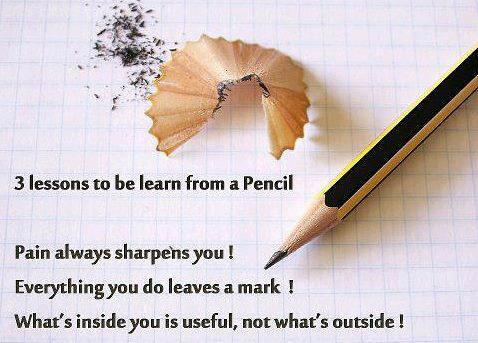
Why use a pen when a pencil is so obviously superior? A pencil comes with an editing device called an eraser. Good writers should use pencils. Because good writers know the importance of a good edit. It isn't about being arrogant the first time you put an idea down. It's about getting it right.
By Julie Wright
Good writers use pens. That's the advice from my tenth grade English teacher, Mr. Cowden. I know I shred this man a lot due to the fact that he singlehandedly tried to put a stop to the writing career dreams of my youth. But I thought of something he'd said all those years ago that struck me as weird today while I edited over some of the new pages I'd written. He said something to the effect of: "Good writers always write in pen because it shows they have the confidence and education to know that they will get it right the first time."
I wanted to be a confident and educated writer. I wanted to be a *good* writer most of all. I wrote with a pen from then on. My first three and a half books were written by hand and all in pen. I have a dozen notebooks filled with pen-scrawled words (and scratched out words and even scratched out pages). It's been years since my handwritten manuscript days, years since a pen was used for anything more than signing a book.
The computer is my new pen. Bless the smart people who created word processing.
Today, I deleted a whole lot. The deletes made the dialogue smooth, the narrative stronger. And I thought back to that day with Mr. Cowden. I thought back to how on some level I must have respected him as a teacher--must have believed his declaration that good writers use pens. Why else would I write with such an instrument for so many years after his class?
I declare my independence from such bad advice.
Why use a pen when a pencil is so obviously superior? A pencil comes with an editing device called an eraser. Good writers should use pencils. Because good writers know the importance of a good edit. It isn't about being arrogant the first time you put an idea down. It's about getting it right.
Thursday, October 1, 2015
Hitting the Top 100 Categories on Amazon
A popular post from March 2014
by Heather Moore
An alternate version of this post previously appeared on Eschler Editing Blog.
Once you have your most-excellent manuscript edited, cover designed, interior formatted into a mobi file, you are ready to upload to the Kindle platform on Amazon. When you load your book to Amazon, every word in your book becomes a searchable item. From the reviews, to the text, to the author bio. Also searchable is the book description and editorial reviews that can be added when you upload. This is why it’s important to select key words that will be repeated throughout each searchable entity.
by Heather Moore
An alternate version of this post previously appeared on Eschler Editing Blog.
Once you have your most-excellent manuscript edited, cover designed, interior formatted into a mobi file, you are ready to upload to the Kindle platform on Amazon. When you load your book to Amazon, every word in your book becomes a searchable item. From the reviews, to the text, to the author bio. Also searchable is the book description and editorial reviews that can be added when you upload. This is why it’s important to select key words that will be repeated throughout each searchable entity.
Before you choose your categories and key words, do
some research on Amazon. Find out what categories bestselling books in your
genre are listed under. Some will be very broad (fiction, romance, suspense),
others will be very narrow (art, Italian hotel, Egyptian History). If you
choose a narrow category, you’ll probably hit the Top 100 a day or two after
your book is listed onto Amazon. With a broader category, you’ll be competing
with other bestselling books in that same category.
This post will give you a quick overview of how
metadata and categorizing works on Amazon, and how it can be a key sales tool
for being a successful Amazon seller. Michael Alvear’s book is great at
explaining how to use metadata effectively in the file creation process, and
how to categorize in the upload process: Make A Killing On Kindle Without Blogging, Facebook Or Twitter: TheGuerilla Marketer's Guide To Selling Ebooks On Amazon.
In
short:
What
is Metadata: Metatags are search terms that readers use to find a book on a specific topic.
What is Categorizing:
Done when the Kindle file is uploaded through KDP on Amazon. You can select 2 categories and 7 keywords that will help your book get categorized and positioned
for selling on Amazon.
Do
now: Put together a chart for your book as you research:
Example for my historical novel, ESTHER
THE QUEEN:
Categories (Amazon allows 2
main categories. I prefer ‘non-fiction’ to capture Top 100. I might go in and
tweak this from time to time as I watch sales.)
|
(I researched a similar genre
book: The Red Tent)
*Religion—Ancient
*Biblical Studies—Old Testament
|
Genre(s) (Amazon gives you 7
categories to list. I may tweak this as well.)
|
Esther, Famous Queens, Adventure,
Judaism, Biblical Fiction, Religious Historical Fiction, Christian Fiction
|
Metadata List
|
Action & Adventure; Religious
Fiction; Queen Esther; King of Persia; Famous Queens; Biblical Queens; Famous
Kings; Biblical Kings; Book of Esther; Judaism; Jewish Life; Jewish Exodus; Middle
East; Biographical; The Heretic Queen by Michelle Moran; Cleopatra: A Life by
Stacy Schiff; The Red Tent by Anita Diamant; Biblical Fiction; Turkey;
Mediterranean; Tombs
|
To explain the chart above. I looked for a
bestselling Biblical novel to compare to mine. I found The Red Tent. These were the categories and rankings:
- #77 in Books > Christian Books & Bibles > Literature & Fiction > Fiction
A non-fiction book on Jewish Life:
- #64 in Books > Religion & Spirituality > Judaism > Jewish Life
I
then went to Christian Books & Bibles, and checked out the books listed in
the top 100. Then I clicked on those books to see what their rankings were. I slowly
built a category list and decided where my book would best fit.
The
Amazon page will also have “Other categories”
Look for Similar Items by Category
- Books > Christian Books & Bibles > Literature & Fiction > Fiction
- Books > Education & Reference
- Books > Literature & Fiction > Contemporary
- Books > Religion & Spirituality > Fiction
Other
examples of books in Top 100 categories and their key words:
Sarah M. Eden’s, Seeking Persephone,
with the $2.99 deal, its rank is here:
- #20 in Books > Romance > Regency
- #66 in Kindle Store > Kindle eBooks > Literature & Fiction > Genre Fiction > Romance > Historical Romance
Spring Vacation Anthology:
Novella, Third Time’s the Charm:
- #11 in Kindle Store > Kindle eBooks > Advice & How-to > Parenting & Families > Family Relationships > Divorce
- #29 in Books > Parenting & Relationships > Family Relationships > Divorce
Heart of the Ocean:
- #88 in Kindle Store > Kindle eBooks > Literature & Fiction > Genre Fiction > Horror > Ghosts
- #98 in Books > Literature & Fiction > Genre Fiction > Horror > Ghosts
Other
concepts recommended by Michael Alvear have to do with the Book Description and
the Reviews. Every word in the description and a review becomes a searchable
entity. In my Book Descriptions when I get a few great reviews, I’ll add them
to the beginning of the description. Some recommend when you ask for a review
to have the reviewer compare it to another best-selling book and use the
Category words… this will become part of the Amazon algorithms.
Here
is a Book Description example that uses key words in the description that will
link the book to other authors and categories. I’ve bolded keywords that will
help this book become categorized more effectively on Amazon. (Age, era,
setting, genre, target audience, comparable authors, comparable books…)
From
Leona & Me, Helen Marie (A Small Town USA novel) by Lu Ann Staheli
Seven-year-old Helen Marie
Heffner has a knack for getting into trouble, followed close behind by her
older sister, Leona Mae. Whether it’s walking the barn beams like a tightrope,
fooling the neighbor boys into thinking they’re being chased by a fiery
jack-o-lantern, or making a mess rather than transferring a pattern for Mama’s
Christmas surprise, Helen comes out the winner every time.
But life is not always fun and games in 1922 for this southern Indiana family. In the wake of the Depression of the previous two years, the girls and their mama are often left alone in Hancock’s Chapel while their papa travels to find work to keep the family finances alive. Lately, Mama’s been showing signs of not feeling well, and Helen is stuck at home, missing the entire school year while she recuperates from the rheumatic fever that struck her the year before. Mama fears the worst is about to happen. Everything from the barn owl, to the chicken thief, the stranger who passed by one evening to a poor neighbor-boy who falls into the ravine, all point to signs of trouble to come. And sure enough, it does.
Leona and Me, Helen Marie, a middle grade novel from A Small Town U.S.A. series, is hometown historical fiction in the style of Richard Peck (A Long Way from Chicago, The Teacher’s Funeral, Here Lies the Librarian) and Kate DiCamillo (Because of Winn-Dixie), with a touch of Laura Ingalls Wilder’s Little House on the Prairie thrown in for good measure.
But life is not always fun and games in 1922 for this southern Indiana family. In the wake of the Depression of the previous two years, the girls and their mama are often left alone in Hancock’s Chapel while their papa travels to find work to keep the family finances alive. Lately, Mama’s been showing signs of not feeling well, and Helen is stuck at home, missing the entire school year while she recuperates from the rheumatic fever that struck her the year before. Mama fears the worst is about to happen. Everything from the barn owl, to the chicken thief, the stranger who passed by one evening to a poor neighbor-boy who falls into the ravine, all point to signs of trouble to come. And sure enough, it does.
Leona and Me, Helen Marie, a middle grade novel from A Small Town U.S.A. series, is hometown historical fiction in the style of Richard Peck (A Long Way from Chicago, The Teacher’s Funeral, Here Lies the Librarian) and Kate DiCamillo (Because of Winn-Dixie), with a touch of Laura Ingalls Wilder’s Little House on the Prairie thrown in for good measure.
Categorizing
is not a one-hit wonder method, but it’s an important marketing tool to use
when selling on Amazon. You can change your categories and key words anytime,
but know that it takes 2–3 days for them to become effective. When I change
them, I wait a few weeks to see which lists are being hit. If I’m not happy
with the results, then I can easily go back in and change them.
Thursday, July 2, 2015
Powerful Dialog: Shorter Is Often Sweeter
A popular post from February 2012.
by Annette Lyon
by Annette Lyon
In the famous movie The Fugitive from the early 90s, Tommy Lee Jones has a fantastic line that people still quote and remember And it's all of three words.
He delivers the line when he's got Harrison Ford's character almost caught, standing at the edge of a water pipe that opens hundreds of feet above a river. Jones's character is simply doing his job to catch an escaped convict.
Ford's character, who was falsely convicted, cries out: "I didn't kill my wife!"
Jones's reply is simple and powerful, and delivered with slow deliberation, almost without emotion from fatigue. "I. Don't. Care."
Kapow.
Not that is effective dialog.
There's more to that line. The story goes that the script originally had several sentences there, a mini speech for Tommy Lee Jones to deliver as to why this isn't personal; he's doing his job, and yada yada.
Jones as an actor had the instinct that shorter is better, to trust the audience to get it. That doing so will be far more effective.
He cut the speech entirely and replaced it with those three words, "I don't care," that communicate more to the audience in three seconds than a three-minute speech could.
Writers could use this as a lesson on how to write good dialog. Pontificating is easy; we writers like to hear ourselves speak (or, er, write). We want to be absolutely sure the reader gets it.
As with so many writing issues, don't stress this too much in your first draft. But when you go through revisions, pay special attention to your dialog and take note of a few things:
- Can some of the words be cut?
- Are characters saying more than they need to?
- Are characters repeating stuff the reader already knows?
- Worse, are characters repeating what every character present already knows, just for the reader's benefit?
- Are characters repeating what someone just said to them? (Such as: "What are you doing here?" with the reply, "What do you mean, what am I doing here?")
- Are they saying something they already said elsewhere (whether in this scene or somewhere else)?
- MOST IMPORTANT: Is the dialog something we can figure out ourselves?
Trust that your readers are smart. They certainly don't need to have you beating a dead horse.
Or even tapping it with a switch.
This is probably the only situation where "show, not tell" ends up shorter rather than longer. Tight, concise dialog shows character and reveals plot so much better than long, meandering passages.
Or even three sentences that could be cut to three words.
Call this The Fugitive effect. I use it all the time on my own work and when editing clients. It's one of my favorite tools.
Subscribe to:
Posts (Atom)


 Posts
Posts


