A popular post from February 2008
by Annette Lyon
I've discussed elements in Vogler's book The Writer's Journey, which is all about the classic mythical structure of "The Hero's Journey" here and here.
Those earlier posts discussed character archetypes and one particular element of the journey (death and rebirth, or the "Resurrection" scene). I thought it was time to discuss the journey itself.
Each step along the way could take up several posts (and indeed takes up its own chapter in Vogler's book). Every story won't use every step, and they aren't always in this order. But I've found the mythic Hero's Journey to be a great guideline, a template that you can refer to when creating an infinite number of brand new storylines.
The mythical story structure has helped me to pack a greater punch in my own writing. If you can read some of Vogler's work, I highly recommend it. I know I'll never read books or watch movies the same way again. Note that The Writer's Journey is out of print, but Vogler has published other works since, and you can likely find a used copy of this one.
Using the classic movie Star Wars, here are the basic elements of the Hero's Journey:
The Ordinary World
We are introduced to the Hero and his/her circumstances. We learn who he is, what he stands for, and possibly what problem is bothering him. Very often the problem we learn about in the beginning isn't the same one we end up solving by the end, because the final problem usually has much higher stakes.
SW: Farm boy Luke Skywalker living a releatively peaceful existence. Although he's an orphan, he lives with his loving aunt and uncle.
Call to Adventure
We learn that the status quo is being upset and that our Hero must take action and go on an adventure. Often a person delivers this call (Gandalf), but sometimes it's an object (the letters from Hogwarts).
SW: We have two calls. First is for the audience, where we learn that Princess Leia has been kidnapped. The second is when Obi Wan wants Luke's help with C-3PO and R2-D2, because they hold the plans to the dangerous Death Star.
Refusal of the Call
The Hero declines the adventure, whether from a character flaw or other reason. He lacks the motivation to leave the Ordinary World, and the call must be issued again.
SW: Luke refuses to help Obi Wan. Luke's motivation changes when until Storm Troopers destroy his village and kill everyone in it, including his aunt and uncle. Now the stakes are higher, and he has a reason to fight.
Meeting with the MentorThis may happen earlier if the Mentor is acting as the Herald and delivering the Call to Adventure. Alternately, the Mentor can give the Hero a "kick in the pants" (as Vogler puts it) to get the Hero movitated and the story off to its real start.
The Mentor trains and/or teaches the Hero and often bestows a tangible gift to the Hero as well.
SW: As a Jedi himself, Obi Wan trains Luke to use the force. He give Luke his father’s light saber.
Crossing the First Threshold
The Hero leaves the comfort of the Ordinary World and enters the unfamiliar territory of the Special World. Once he crosses over, he has committed to the adventure, life (and The Ordinary World) will never be the same again.
Often the Hero will be tested by a Threshold Guardian (a character or situation) blocking his path, which he must get beyond to prove that he's committed and worthy of being the Hero. Arriving in the Special World can be another test, as we see how quickly the Hero adapts to the rules of the new World.
A "Watering Hole" scene is common after arrival, where the Hero meets locals in a tavern or other public place of food and refreshment. A brawl or other test may appear.
SW: Luke travels to find a pilot to help, and he meets Han Solo in a tavern.
Test, Allies, EnemiesThis portion covers a good chunk of the middle portion of the story. The Hero is tested in increasingly challenging ways. He learns who are his allies and who are his enemies.
SW: Han Solo & Chewbacca become Allies to aid in the rescue of Princess Leia. They get through an Imperial blockade, discover that the Princess's home planet of Alderaan has been destroyed by the Death Star, etc.
Approach to the Inmost CaveThe Hero is given an even greater test as he gets through more obstacles and must use his recently-learned skills as he approaches the darkest place that will hold the greatest danger and his ultimate Ordeal.
SW: They are pulled into the Death Star.
ResurrectionThe Hero dies or appears to die and is "reborn" with new life and determination, new lessons learned. This propels him into the final act.
SW: Luke appears to die in the Death Star's trash compactor, but reemerges triumphant and ready to fight again.
OrdealA true test of the Hero, that challenges him to draw upon all the lessons he's learned and all the skills he's acquired on the journey. He often battles the Shadow (the villain) and will have to sacrifice, often allies.
SW: The huge battle at the Death Star.
Reward—Seizing the SwordThe Hero emerges from the Ordeal triumphant, carrying the "sword," or whatever symbolizes that success, whether it's accomplishment of a mission or capture of a treasure.
SW: The Death Star is destroyed
The Road Back
The Hero begins heading back to the Ordinary World, but encounters new struggles along the way (chases are common here). He must cleanse himself of the battles he's been through.
SW: Darth Vader & his henchmen chase the heroes as they try to make their escape.
Return with the ElixirThe Hero returns triumphant, having proven himself a true Hero. He has the Elixer, which is a something valuble he has learned, acquired, or accomplished that he shares with others.
SW: Luke has (for now) defeated Darth Vader and restored peace to the galaxy.
That's a brief overview, but it should be enough to get you thinking of some of the plot structures in your own work. Do you have a death/rebirth? What is the Elixer your Hero will return with? Does your Hero have enough Threshold Guardians, blocking his way and proving his mettle?
Play with the forms and analyze some of your favorite stories to see what elements fit where. It's a great structural exercise that will enhance your writing.
Showing posts with label Writing Books. Show all posts
Showing posts with label Writing Books. Show all posts
Monday, May 1, 2017

Wednesday, April 26, 2017
Why is Editing so Hard?
A popular post from February 2008
By Heather Moore
Like many of you, when I sit down to write, I love the feeling of accomplishment. Recording the number of words written at the end of a writing session gives me a tangible record of achievement. It’s better than getting all of the laundry done, or having a clean house. Because by the next day, laundry has started to pile up again, and the kitchen counters are stacked with more homework.
But that word count continues to grow each day, and no one can change that . . .
Until it’s time to edit.
Editing is like lugging that basket of dirty clothes, again, to the laundry room. It’s like seeing the dishes piled in the sink—when it seems you’ve just washed them.
Editing is work.
There are times when I get an edit back from a fellow reader—and although I’m so grateful for the time they put into reading my manuscript—I know the next few days are not going to be easy. Every correction brings me closer to a cleaner manuscript, but there are those comments that I dread. You know the ones, “I can’t picture this.” “This isn’t consistent with the character.” “Your man sounds like a whiny woman.”
Those are not quick fixes. They take re-evaluation, re-thinking, and re-writing. Just plain work, and lots of time.
So to make editing more bearable I’ve come up with a few suggestions.
1. Turn on your favorite music.
2. Get out that chocolate.
3. Only do a set number of pages a day so that you don’t get too frustrated. Anywhere from 20-50 should do it.
4. Do the quick fixes first, and set aside the pages with the harder rewrites. Then come back at the end and work on the more difficult editing. By then, you’ll have whittled down the imposing stack of 300 pages to a mere 20-30 pages.
Monday, March 27, 2017
Resolutions Writing Style
A popular post from January 2008
by Annette Lyon
As you begin a new year of writing, you might want to make making some writing-related resolutions.
First, take stock of what worked for you in 2007 and what didn't. Do daily word count goals fit your lifestyle? What about weekly ones? Do you work better by tracking chapters or pages rather than words? What system works best for you?
Second, set goals for yourself--goals that, while reachable do require you to stretch a little.
Last, decide on rewards for each goal you meet. It's amazing how a little incentive can help yourself plant your behind in the chair and your hands on the keyboard. Your inner writer is a child. Bribe it! (I find chocolate works well. And pedicures.)
Consider adding some of the following when making your list:
- Read. A lot. It helps me to keep a running log of all the books I've read in the year. I've done this every year for over a decade, and I try to at least match if not beat the number of titles from one year to the next. A good writer is a good reader. Be sure to include writing books in your list. And don't forget to read works in the genre you write in. Add one or two books that stretch you.
- Take regular outings to places that bring something new to your senses: try new foods, visit a museum, take long a walk through a strange neighborhood, go on vacation to a place you've never been before. Stimulation to the senses does marvels for creativity.
- Proof every query, cover letter, and manuscript you send out. Many times.
- To help you send out the cleanest material possible, learn your punctuation and grammar rules. (A funny and great place to start: Eats, Shoots, and Leaves, by Lynne Truss.)
- Get up the guts to show your work to someone other than family and friends . . . someone who will give you the honest truth. Consider hiring a professional. It's worth the cost.
- Make at least one big goal for yourself: I'll finally finish this book/I'll query 20 agents/I'll attend 2 writing conferences. And attach deadlines to each goal.
Monday, February 20, 2017
To begin is human . . .
A popular post from September 2009
By Heather Moore
I’ve been to many writers conference over the past eight years, and listened to maybe close to 100 presenters. I’m at the point where I’ve heard pretty much everything, so I rarely take notes anymore. Mostly I’m interested in publishing stories—as in how did this bestselling author get his/her start?
At the Book Academy conference held at Utah Valley University this past week, Brandon Sanderson was the keynote speaker. If you are a fantasy writer, for children, YA, or adult, his books are a must-read. He writes the Alcatraz series for middle-grade readers (they are hilarious for adults as well. Also, for you omniscient pov writers, this series is a classic example). He also writes epic fantasy. Elantris is his first published, and the Mistborn trilogy has propelled him to pretty much stardom. I'm dying to read Warbreaker, his newest release, but I'm trying to get my WIP progress drafted first.
Brandon talked about how he wrote novel after novel (I think it was 12-13) before he finally got his #6 book a publishing contract. When he heard from the editor who wanted to buy his book, he contacted an agent who he’d gotten to know over the years through various writers conferences. The agent signed him.
Brandon gave some advice on things he wished he would have known before he tried to follow market trends (which wasn’t successful for him). I won’t reiterate it here since I don’t want to plagiarize, although I did ask him if it was okay to blog about it. And I think he said yes. Or maybe I just told him I was going to, and he looked at me funny. I’m not sure (since when I'm around famous people I'm lucky to remember my name), so to be on the safe side, I’ll just tell you about one of the things he emphasized.
“Write what you like to READ.”
This sounds so simple, but when you really think about it, it makes a whole lot of sense. This can solve some of our writer’s angst when we are trying to think of a new genre to break into. Say you are published in historical fiction (like me!) and you see all of your friends getting huge advances in children’s lit. Hmmm. Should I switch genres? Catch the tide? Do I love children’s lit or am I just trying to copycat?
So I pause and ask myself: “What do I READ?” That’s the answer. If I don’t like to read what I’m writing, then guess what? The passion will fizzle out all too soon.
So, like Brandon, who decided to not follow the tide and write what he was passionate about (Epic Fantasy), I think I’ll do the same—not the same genre, but you know what I mean.
One last quote from Mr. Sanderson, which I thought about putting on my whiteboard in my office, but then didn’t want to be reminded of a big revision in my near future:
“To begin is human.
To finish is divine.
To revise is hell.”
Monday, January 16, 2017
Characterization: It’s hard to do
A popular post from July 2009
By Heather Moore
The other night I saw “The Proposal” with a friend of mine. Whether or not you like “chick flicks” there were some great characters in there. Yes, a little predictable, but sometimes when watching a movie and analyzing characters, the “aha” light goes on. It’s a little easier to define why one character works and is endearing or relatable, while another might not be, when you see a 2 hour movie.
But what I really want to discuss is a movie I saw a couple of weeks ago, called “New in Town.” Renee Zellweger’s character is a smart, classy, climbing-the-corporate-ladder type. (Incidentally this was the same character-type as Sandra Bullock in The Proposal—but Sandra played it oh-so-much better).
The plot for “New in Town” and Renee’s character were cliché-ish and quite predictable. Renee’s job was to go into a small-town manufacturing plant, that the corporation she worked for had purchased, and to make it profitable. But who shined in the movie was the secretary, played by Siobhan Hogan. She was quirky and her famous, but top-secret, Tapioca recipe became an integral part of the plot. Siobhan’s character “stole the show” and her naivety and small-town good-heartedness felt real, easy to relate to, and easy to picture her as your neighbor.
Here are the things that made up her character:
-Loves scrapbooking, finds value in it and spends time with her neighbors doing it.
-Is the type of person to invite others over for dinner, even if it’s just meatloaf. Which leads to that she’s the type of person who doesn’t put on airs. Meatloaf is good enough for her, so it’s good enough for anyone else.
-Generous and willing to share her Famous Tapioca. Yet, she will not give out the recipe no matter how she is bribed.
-She is trustworthy and trusts back. Also a peacemaker.
-She is a romantic and wants everyone to be happy.
-She lives in a very cold climate but makes the best of it.
-She states her opinion but doesn’t force it on anyone.
-She’s a bit naïve and goes through several upsets because of it.
-She is funny, but unassuming.
-Even when she is emotionally distraught, she makes Tapioca and takes it over to her “enemy”.
I hope this gives you a more rounded view of characterization. It’s not just about description, but about the core of the person. When faced with two choices, which choices would your character make?
For a quick study (and a quick read), I’d recommend Everything is Fine by Ann Dee Ellis. She is a YA author, and her characterization of Mazzy was impressive in that book.
Monday, December 19, 2016
Beauty Out of Context
A popular post from April 2009
By Julie Wright
Several years ago, the Washington Post convinced Joshua Bell, a world acclaimed violinist, to dress in simple jeans and a t-shirt and to take his $4,000,000 Stradivarious down into the subway to play for the masses. The experiment was to see if people recognized great art out of context.
Within 45 minutes, 1097 people passed by the violinist playing his little heart out. Only seven people stopped for any duration of time to actually listen. Joshua Bell is a man who can fetch seat prices of $100.00 for merely adequate seats in a symphony hall and much more for good seats. Joshua Bell is a master. Only 7 people stopped for beauty, recognizing it for what it was.
What has this to do with writing, and more importantly with you?
I recently heard an editor say that they don't normally take middle grade work, but if Neil Gaiman walked in, they would never refuse him simply because his protagonist's were a little young for this imprint. They could say this because they know Neil Gaiman. He's been declared beautiful by literary standards.
But what if he showed up looking like everyone else? What if he came in out of context? What if he came through the slushpile as an unagented author without the Newbery sticker? Would they recognize him for who he was? A few might . . . but I'd bet most wouldn't. (and by the way, I loved The Graveyard Book)
The point is that you may be the next big thing--stamped with the approval of the literary world. Your manuscript may be beautiful, but not recognizable exactly yet. Don't obsess or let it get you down. Joshua Bell stood in the masses and played beauty. Few actually stopped for beauty. It's not to say the music was any less beautiful down there in the subways, but that out of context, it was harder to see, harder to pay attention to as the people scurried about with thier lives. The world just works like that.
Life gets out of balance and the subjective nature of art makes rejection inevitable.
Take a moment to view the entire article as it is beautiful in its own way and deserves to be read:
http://www.washingtonpost.com/wp-dyn/content/article/2007/04/04/AR2007040401721.html?hpid=topnews
Wednesday, December 7, 2016
Publication Timelines
A popular post from May 2009
by Heather Moore
Admit it. When you wrote your first book, you thought you'd find a publisher within a few months, and your book would be out before the year was up. Right? Now that you know better, here is the real story:
27 months . . .
My first book that I got published took 6 months to write, 2 months to edit, 10 months to hear back from the publisher, 9 more months to be released. Total time: 27 months
When you show up at an author’s book signing for his/her latest release, you should ask, “What are you working on now?” Chances are they are writing a book that will come out after the book that they just submitted or had accepted. Clear as mud? The reader sees the new release as the fruits of an author’s labors about 1-2 years after the book was actually written.
Often, when I’m at a book signing promoting my newest book, I’m in the throws of writing the next thing.
A sneak peak at my projected schedule:
*2008
July-November: Writing Historical Book “B” (sequel to “A”)
November: Historical Book “A” is released (written in 2007)
*2009
January: Book “B” accepted
January-July: Writing Non-Fiction Book
July-November: Writing Book “C”
Sept/Oct: Book “B” released
Waiting for news on book “Q”
Will start a sequel for book “Q” if it’s sold
*2010 Projection
Spring: non-fiction book released (if accepted by publisher)
Fall: Book “C” released (if accepted by publisher)
Fall: If “Q” book sells in 2009, it may come out 2010 or 2011
Currently I have book “Q” with an agent. I wrote the book Spring/Summer 2006. I handed it off to readers Summer/Fall 2006. In January 2007, I had an agent’s interest but she didn’t like the ending. I did mass revisions and finished them Summer 2007. The agent never responded back. At the beginning of 2008 I found another agent. A year later in January 2009, the book was “approved” for shopping (after more revisions). Five more months have passed. This might be a record. 36 months total . . . and counting.
Now, just for fun: The book “A” that I wrote Summer/Fall 2007 and was released Fall 2008, guess when I received the first royalty check? February 2009.
Wednesday, October 5, 2016
The Almighty Edit
A popular post from March 2013
by Julie Wright
by Julie Wright
As an editor, I get to ruin a person's day. As a writer, I
get my day ruined by editors.
I know it's important, the job of an editor. I know I'm
helping other writers. But as a writer, I don't know what I'd do without a good
editor. A good editor is what saves you from yourself. He or she will save you
from certain embarrassment if that scene or sentence actually makes it into the
final version of your manuscript.
This post might seem a bit like an ode to editors past, but
I would be remiss if I didn't mention the editor who changed my life as a
writer.
Kirk
Shaw was/is (he's at law school, now) a great editor. I owe many thanks to him
for saving me from myself. He told me what scenes were lame and needed to be
cut. He told me when I was going too easy on my characters and in what ways
they could stand to suffer a little more. He taught me several comma rules. I
still don't know all the fickle ways of the comma, but that's merely because we
didn't have enough time together. The man was a genius at his job.
Some
good things to keep in mind when editing your own manuscript
- Make your characters work for it. If the quest is too easy, it's not worth reading about.
- If a word is not a contributing member of the sentence, then it needs to be evicted. Make sure your words all have a specific function.
- If a sentence is not a contributing member of your page, then it needs to be evicted.
- If a page is a not a contributing member to the story, then it needs to be evicted. Don't let the dead weight take up residence in your story.
- Cutting hurts. But a tight and tidy package looks nicer and is better received than the one hastily slapped together with a few errant pieces of tape and rumpled wrapping paper.
- There is a difference between the words lightening and lightning. Make sure you used the word you meant to use. Spell check doesn't catch this.
- There is also a difference between a nice dress and a mice dress. Sometimes you hit a wrong key, but the word still fits well enough in the sentence that spell check doesn't see it. Make sure you are reading your story out loud during your final editing stage. You catch so much more when you're reading it out loud and having to say every word as it is written.
- Do your characters have a goal they're working toward or are they just playing around?
- Avoid passive language--especially in a book meant for action and suspense. The active voice makes the scene more immediate and urgent. The passive voice slows everything down.
- Editors
never use the phrase "Show, don't tell" because they think the words
sound pretty together. When you see that phrase, take it to heart. Showing
versus telling makes the difference between meh and amazing. It is the plastic
roses bought at a dollar store on clearance versus a fresh bouquet from one of
the nicest florist shops in town. Always act on this directive when an editor
tells you it is needed.
CS Lewis has this quote:
“Imagine yourself a living house. God comes in to rebuild
that house. At first, you can understand what he is doing. He is getting the
drains right and stopping up the leaks in the roof and so on. You knew that
these jobs needed doing and so you are not surprised. But presently, he starts
knocking the house about in a way that hurts abominably and seems not to make
sense. What on earth is he up to?
The explanation is that he is building quite a different
house from the one you thought. He is throwing out a new wing here, putting on
an extra floor there, running up towers, making courtyards. You thought you
were going to be made into a decent little cottage, but he is building a
palace."
Your manuscript is your house. Build a palace.
Monday, June 13, 2016
The Middle of Nowhere
A popular post from September 2011
I live in the literal middle of nowhere. Getting to my house is one of those experiences where you start out thinking about how fun the road trip is going to be. You take off with your snacks, and your drinks, and your awesome music you can sing along with. But once you leave the freeway and enter the highway, things feel less promising than they did when you took off. You're moving slower because the speed limits are so incredibly lamely LOW, and sometimes you get stuck behind semi trucks who make the lame low speed limit look like Nascar, and the scenery doesn't feel like it's changing. It's more of the same thing over and over and over. And sometimes you get stuck out there in the middle--due to cattle or sheep, or rolled semi trucks (it happens). Sometimes you get stuck for a long time and it totally bites because there isn't even any cell service.
People show up at my house and come panting in my living room and plopping down on my couch with great exclamations of how they NEVER thought they would get there.
I get them a drink and lament American highways with them because it's the right thing to do. It really is a long drive--necessary for me, but long.
Writing feels similar sometimes.
You get this great idea--this epic, amazing, you-can't-believe-the-idea-actually-came-to-you idea, and you take off, writing furiously. You've got your snacks, your drinks, your best writing music, and you are so excited about what you're working on, you can barely keep the grin off your face. You know that the ending of this work will be colossal, amazing. You're thrilled with how fantastic the destination of the end of your book will be for readers of all ages. You are going to change the world.
Until you find yourself in what feels like the two-lane-highway-stuck-behind-a-semi-truck part of your book.
Welcome. You've now reached the middle.
And you start to doubt.
Is this really where you wanted to go anyway? What's so great about reaching "the end?" Maybe that beginning was the mistake. Maybe you took a wrong turn somewhere . . .
So instead of writing, you rearrange your pen collection, get up for a different snack--you were sick of chips anyway and realize carrot sticks might be healthier. You punch some buttons on the remote control to see what might be on.You call your friends and see about going to a movie, but they're busy writing--jerks, and then you decide that health is overrated, and you wanted ice cream instead.
There are some things you can do to pass the semi--clear the flock off the road, and get back to the freeway that will take you where you want to go.
Boring:
Are you bored? If you're bored, I promise, your reader is too. If that's the reason the middle's slowing down, then you might want to insert some action, some peril, something that incites your characters and your readers. Put them in danger, make the girl lose the guy, have the murderer strike again while the detective is still scrambling with clues. Make something happen that propels the action and the plot forward again.
Goals:
Does your character not have clearly defined goals so your characters are kind of wandering around in the misty middles of nowhere because they're not sure what to do next? if this is the case, go back and find something your character desperately wants or is desperately passionate about. That is the goal. Keep them moving toward the goal, which will help move them away from the middle and closer to the end. Make sure the goal is big enough that the readers will care if the goal is achieved. If the quest is merely for a pint of ice cream--you might not be able to get the reader to follow the journey to the end. Make it riveting enough to hold your attention.
Make sure your antagonist has a clear goal too. No one is evil just for the sake of evil. They have things they want and are trying desperately to achieve.
I have a tendency to get lost in my manuscripts about page 60, and then again at page 120. But I've always found that it's because I've lost sight of the goal or failed to keep the action and plot moving. Middles don't have to feel like the boring nowheres they sometimes seem to be. Take the scenic route and turn your music up louder. And remember to have fun with it!
Tuesday, October 27, 2015
The Importance of Plot
A popular post from February 2013
by Julie Wright
I am a character driven writer. For me, everything starts with that one character who says something, or thinks something, or feels something huge. I am also what some have termed a discovery writer. Outlining is something I've tried, and failed, at doing.What's the point of writing it all down if you already know the ending?
My messy methods work for me. I have pages of scribbled notes tucked into filing cabinets and several pages more frantically typed into documents on my hard drive. Character sketches, dialogue lines, careers for my characters, ways to poison people, how to knock a guy out in one clean punch.
It's like the makings of a perfect dinner. All the ingredients are there waiting to be blended, molded, wrapped into something tasty.
Only there is no recipe.
As an aside, it's funny I'm making a food metaphor since I don't cook. EVER. I once told my husband I don't read recipes because they don't have a plot.
Which makes this even funnier because that is exactly what I wanted to talk about today. Plot. your recipe *is* your plot. It is how you blend your characters, dialogue, clever means of escape, cool careers, and settings.
An egg by itself is a little boring, but with the right ingredients and a good recipe, it can be pulled into an amazing creme brulee. That is what your plot does. It pulls all your ingredients together so they work.
I've done a lot of reading and editing lately, and I've found that the books that hook me immediately are the ones with a clear plot structure. They are the ones that immediately pose a major dramatic question. I keep turning pages because I MUST discover the answer. The books I've put down are the ones that meander all over the place. Sure they have several pairs of pretty words strung together, but that doesn't make them good stories. The ugly truth of writing is that at any point, the reader can say, "Meh, not interested."
The major dramatic question is what drives the story: Will the detective discover who the killer is before he strikes again? Will Earth survive the alien attack? Will the family who bought that new house be able to overcome the ghost who already resides there? Will Elizabeth Bennett and Mr. Darcy ever realize they love each other? (of course they will!)
Many genres have a "formula" to the big dramatic question. Romance is one of those genres that is very formulaic. There isn't anything wrong with that. It would kinda ruin the genre if it didn't. Imagine if you spent all that time with the couple and all their sexual tension and banter, and they didn't ever get together. You'd feel totally ripped off. What if the detective never finds the killer and he strikes again and again and again, but no one ever stops him? That's a crummy story.
So, it isn't about knowing the protagonist will eventually get what they want, it's about the how. it's the twists and turns, the missteps and failures.
Your protagonists must have things getting in the way of them getting what they want. They need to try and fail. They need to try and fail several times. A few years ago, I seriously read a 500+ page book about everything going right for the protagonist. The protagonist didn't have to overcome or grow in any way. I was judging a contest so there was no mercy. I couldn't put it down. In order to be a fair judge I had to read every. single. painful. word.
After the protagonist tries and fails, tries and fails, they get to the climax, that defining moment where it all comes together. Where the heroine finally kisses her hero and knows he belongs to her. Where the detective has finally stopped the killer and saved the next victim just in time.
Dan Wells taught an amazing class about plot structure. Go view it. (ignore the irritating music at the beginning and end.) He taught that knowing where you want to end up helps you as a writer to discover how to get there. If you want your character to end one way, you need to start them at the polar opposite of where they end. If you want her to end with love, you need her to start with absolutely no prospects of love, destined to be a creepy, old cat lady who trips young lovers with her cane as they walk past her on the pier. Then you add plot twists. Places in the story that change who this character is.
Even if you're like me, a discovery writer, you need to know how you plan on the story ending, so that you can know how to start it accurately. You need to know the defining moments that help drive the story to that eventual ending.
So now I'm curious, What camp do you fit in: discovery writers or the outliners?
Monday, October 5, 2015
Good Writers Use . . .
A popular post from November 2013
By Julie Wright
Good writers use pens. That's the advice from my tenth grade English teacher, Mr. Cowden. I know I shred this man a lot due to the fact that he singlehandedly tried to put a stop to the writing career dreams of my youth. But I thought of something he'd said all those years ago that struck me as weird today while I edited over some of the new pages I'd written. He said something to the effect of: "Good writers always write in pen because it shows they have the confidence and education to know that they will get it right the first time."
I wanted to be a confident and educated writer. I wanted to be a *good* writer most of all. I wrote with a pen from then on. My first three and a half books were written by hand and all in pen. I have a dozen notebooks filled with pen-scrawled words (and scratched out words and even scratched out pages). It's been years since my handwritten manuscript days, years since a pen was used for anything more than signing a book.
The computer is my new pen. Bless the smart people who created word processing.
Today, I deleted a whole lot. The deletes made the dialogue smooth, the narrative stronger. And I thought back to that day with Mr. Cowden. I thought back to how on some level I must have respected him as a teacher--must have believed his declaration that good writers use pens. Why else would I write with such an instrument for so many years after his class?
I declare my independence from such bad advice.
Why use a pen when a pencil is so obviously superior? A pencil comes with an editing device called an eraser. Good writers should use pencils. Because good writers know the importance of a good edit. It isn't about being arrogant the first time you put an idea down. It's about getting it right.
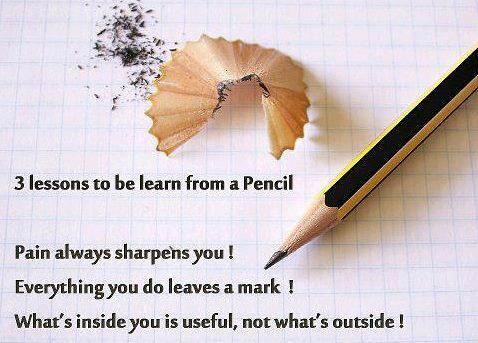
By Julie Wright
Good writers use pens. That's the advice from my tenth grade English teacher, Mr. Cowden. I know I shred this man a lot due to the fact that he singlehandedly tried to put a stop to the writing career dreams of my youth. But I thought of something he'd said all those years ago that struck me as weird today while I edited over some of the new pages I'd written. He said something to the effect of: "Good writers always write in pen because it shows they have the confidence and education to know that they will get it right the first time."
I wanted to be a confident and educated writer. I wanted to be a *good* writer most of all. I wrote with a pen from then on. My first three and a half books were written by hand and all in pen. I have a dozen notebooks filled with pen-scrawled words (and scratched out words and even scratched out pages). It's been years since my handwritten manuscript days, years since a pen was used for anything more than signing a book.
The computer is my new pen. Bless the smart people who created word processing.
Today, I deleted a whole lot. The deletes made the dialogue smooth, the narrative stronger. And I thought back to that day with Mr. Cowden. I thought back to how on some level I must have respected him as a teacher--must have believed his declaration that good writers use pens. Why else would I write with such an instrument for so many years after his class?
I declare my independence from such bad advice.
Why use a pen when a pencil is so obviously superior? A pencil comes with an editing device called an eraser. Good writers should use pencils. Because good writers know the importance of a good edit. It isn't about being arrogant the first time you put an idea down. It's about getting it right.
Friday, January 29, 2010
Kelli Stanley: From Small Press to Big Success
Interview by Heather Moore
Welcome, Kelli, to our writing blog. We’re excited to hear about your writing journey and how you went from getting your first mystery novel, Nox Dormienda: A Long Night for Sleeping, published with a smaller press to landing a contract with a major publisher for City of Dragons.
And, of course, perseverance counts the most. You just can’t give up, though there have been times that I’ve thought I should.
Heather: Perseverance is even more important than ever. The typical writing process can take years from writing, to submitting, to a book release. I think it’s important for novice writers to understand that the success we see splashed in the newspapers and magazines has been a long time in building up. What are your writing habits—and how long does it take you from idea to completion of a novel?
Kelli: I hold a day job, so writing has to be worked in around everything else. And though I use a loose outline, the plot also develops as I write—characters come in I don’t expect, etc. I prepare a certain amount of research ahead of time, too, but also research specifics as they come up. So all in all, I’m usually a fairly fast writer, but how long it takes to get to the finished product depends, like everything else, on other demands: day job, personal and family life … and certainly, all the editing, marketing, etc. that goes into launching a new book.
Heather: Like the rest of us, you are juggling many things. Gratefully, the internet has given authors instant access to self-promotion. How important is internet presence (websites, blogging, social sites) to your marketing?
Kelli: Enormously important. The internet is where most people receive their news, their impressions of what might interest them. The trick is to figure out what—of the million on-line opportunities out there—might work. I wish I had the answer! Social networking is fun—and when you spend a lot of time staring at a page, it’s great to take a break and connect with friends and readers. But—the downside—it can be an enormous time drain. So you have to constantly remind yourself, again, that you’re a business, and you don’t have time to harvest your crops in Farmville.
Heather: LOL. The other day I deleted about 30 requests for Farmville and finally blocked it. Based on your experience, would you advise an unpublished writer to submit first to small publishers or to find an agent?
Kelli: Unpublished writers, in my opinion, should ALWAYS seek an agent first. Even with a small press, agents will recognize a one-sided contract when they see it. If I’d had an agent when I signed my contract for NOX, we could have bargained for a much better deal in terms of length of ownership of rights, etc. All kinds of things you don’t think about—or at least I didn’t, because I didn’t know any better. An agent will protect you from getting taken advantage of because you want something—to be published—very, very badly. That’s their job, and they can and should be a writer’s best friend.
And the impossible did happen! My editor bought the sequel to NOX, so both series are now with Minotaur. CURSED should be out maybe at the end of this year, maybe early next year—I’m not sure yet. Meanwhile, I’ve got my hands full with the second Miranda book and launching CITY OF DRAGONS!
Heather: Congrats, Kelli, and thanks so much for taking time out of your busy promotion schedule! You can read Chapter 1 of CITY OF DRAGONS here. Also, visit Kelli Stanley's website for upcoming events, reviews, book trailers, interviews, and more.
Welcome, Kelli, to our writing blog. We’re excited to hear about your writing journey and how you went from getting your first mystery novel, Nox Dormienda: A Long Night for Sleeping, published with a smaller press to landing a contract with a major publisher for City of Dragons.

Heather: First of all, congratulations on your starred reviews from Library Journal, Publishers Weekly, and Booklist for City of Dragons! Pretty amazing to say the least. But first things first . . . I recently read your award-winning mystery novel, Nox Dormienda (an Arcturus mystery) and really enjoyed the classic Roman noir setting. Tell us about the beginnings of your publishing career with this first book.
Kelli: Heather, thank you so much for having me over! It’s an honor to be here at Writing on the Wall. And thank you very much for the kind words! I wrote NOX DORMIENDA just a few years ago when I was in graduate school, earning a Master’s degree in Classics. It was the first novel I ever tried to write, but I’d written “stuff” my whole life, from poetry to screenplays. I wanted to do something creative with my degree—and my life. My choices were really to either go forward in academia, pursuing a Ph.D., or try something new. So inspired by the success of writers like Stephen Saylor and Lindsay Davis, I took the plunge and wrote NOX, which combines my love of noir and hardboiled fiction and film with the history and culture I’d spent so much time studying.
Contrary to expectations, I found an agent immediately—the first agent I queried, in fact. However, she moved out of the country and I was left—in my graduating semester—with very few prospects. That was a scary time, let me tell you. And to compound the stress, I was operating in a vacuum of ignorance. I knew no one in the community, I wasn’t a member of any organization—no Sisters in Crime, no Mystery Writers of America. I’m kind of mule-headed (some in my family might say VERY mule-headed, lol!), and I just didn’t feel comfortable investing any money in myself if all this publishing stuff was a pipe dream. So I wasn’t sure what to do. My former agent suggested I submit the manuscript to Five Star, a small, library press—they get their books reviews and it seemed like a good place to start. I thought to myself, “Just get a toe in the doorway.”
So I sent the book to Five Star and I was accepted. And it was at that point that I started to actually believe in myself, and promptly tried to make up for all the lost time and join organizations and learn as much about the industry as possible. After this start, you can imagine my surprise and gratitude at NOX winning the Bruce Alexander and becoming a Macavity finalist last year. 
Heather: That must have been a thrill to have NOX in such a prestigious way. You have written a sequel for Nox Dormienda, but that’s not the next book coming out. City of Dragons was picked up by Thomas Dunne/Minotaur and will be out February 2, 2010. How did you find your agent for this book and how long did it take to secure a publishing contract?
Kelli: There are a lot of characters and plots roaming around in my head, and I never planned to just focus on Rome—too limiting. My true love is mid-century America, particularly the 30s through the end of World War II. So I planned to write a novel with a female private detective, and I was going to set it in 1939, at the San Francisco World’s Fair—the Golden Gate International Exposition.
Now, once I realized that it would be very, very difficult—almost impossible—to get my first series picked up by a major publisher, I knew that writing another series would provide me a fresh chance. Fortunately, I’d written CURSED, the sequel to NOX, in just a few months—before I submitted NOX and while I was waiting to figure out what to do with my life.
So I wrote CITY OF DRAGONS. The book became darker, set in 1940, and while the Fair plays a role—and is actually the setting for a Miranda Corbie short story that’s coming in the FIRST THRILLS anthology in June—Chinatown is the backdrop.
In the meantime, I was without an agent, and knew I’d have to go through the tortuous process of finding one. A friend recommended her agency, I sent them my work, and found the absolutely best agent in the world—Kimberley Cameron, of Kimberley Cameron and Associates. I finished CITY OF DRAGONS a few months after NOX was published, and Kimberley put it on the market in the second week of January, 2009. The market fell out and I was petrified it wouldn’t sell. But three weeks later we had a deal with Thomas Dunne/Minotaur, and believe me—I couldn’t be happier. I adore my editor and my publishing team! 
Heather: I’ve heard Kimberly Cameron is an excellent agent. Congratulations. I think every writer was holding her breath when the market went south. But you are one of the survivors. The cover for CITY OF DRAGONS is stunning, so kudos to your publisher's design department. What are some of the key things or mottos that you believe have attributed to your success as an author?
Kelli: My family, number one. They’ve believed in me from the beginning, and help prop me up through all the self doubt. And the generosity of this community—the crime fiction community—is unbelievable. I have been helped and supported by so many people … and one of my goals is to be able to give back in any way I can.
I also think it helps that my expectations are fairly realistic—I want to write full-time. That’s it! And I recognize that publishing is a business—that writing is a business, and that authors really need to look at themselves that way.
And, of course, perseverance counts the most. You just can’t give up, though there have been times that I’ve thought I should.
Heather: Perseverance is even more important than ever. The typical writing process can take years from writing, to submitting, to a book release. I think it’s important for novice writers to understand that the success we see splashed in the newspapers and magazines has been a long time in building up. What are your writing habits—and how long does it take you from idea to completion of a novel?
Kelli: I hold a day job, so writing has to be worked in around everything else. And though I use a loose outline, the plot also develops as I write—characters come in I don’t expect, etc. I prepare a certain amount of research ahead of time, too, but also research specifics as they come up. So all in all, I’m usually a fairly fast writer, but how long it takes to get to the finished product depends, like everything else, on other demands: day job, personal and family life … and certainly, all the editing, marketing, etc. that goes into launching a new book.
Heather: Like the rest of us, you are juggling many things. Gratefully, the internet has given authors instant access to self-promotion. How important is internet presence (websites, blogging, social sites) to your marketing?
Kelli: Enormously important. The internet is where most people receive their news, their impressions of what might interest them. The trick is to figure out what—of the million on-line opportunities out there—might work. I wish I had the answer! Social networking is fun—and when you spend a lot of time staring at a page, it’s great to take a break and connect with friends and readers. But—the downside—it can be an enormous time drain. So you have to constantly remind yourself, again, that you’re a business, and you don’t have time to harvest your crops in Farmville.
Heather: LOL. The other day I deleted about 30 requests for Farmville and finally blocked it. Based on your experience, would you advise an unpublished writer to submit first to small publishers or to find an agent?
Kelli: Unpublished writers, in my opinion, should ALWAYS seek an agent first. Even with a small press, agents will recognize a one-sided contract when they see it. If I’d had an agent when I signed my contract for NOX, we could have bargained for a much better deal in terms of length of ownership of rights, etc. All kinds of things you don’t think about—or at least I didn’t, because I didn’t know any better. An agent will protect you from getting taken advantage of because you want something—to be published—very, very badly. That’s their job, and they can and should be a writer’s best friend.
That said, it takes time and perseverance to find the right agent for you. Think of it like a marriage—you wouldn’t fly to Las Vegas together on the first query letter, so take the time to research the agents you submit your work to, take time to ask them questions. Research their reputations, email their clients. It’s a personal relationship as well as a business one, and it needs to click.
Heather: Research is so important. I had an agent once send me a contract and only after the fact did I do the research. Every author I contacted told me NOT to go with that agent. It would have saved me a lot of time and heartache if I’d done the research in advance. What additional advice would you give to those dreaming of becoming published writers?
Kelli: Take a piece of paper and paste this to your computer: Butt in Seat. That sums up what you have to do … sit there and focus and finish the book. Don’t send anything to anyone that is unfinished. Finish it, have done with it, make sure you’re happy with it, but don’t endlessly tweak it, either. Then start the query process.
And don’t repeat the mistake I made. Join Sisters in Crime, join International Thriller Writers and Mystery Writers of America! You’ll learn so much, and all of it will help. You’ll meet writers who might blurb your book when you get your contract, you’ll meet agents, you’ll learn about the industry. If you’re serious about being published, you have to be serious about the business, and these organizations will help.
Heather: Excellent advice. Tell us about the book(s) you are working on now.
Kelli: Right now, I’m working on the sequel to CITY OF DRAGONS—the working title is COUNTRY OF SPIDERS, but that may change. I’ve got a Miranda Corbie short story called “Children’s Day” coming out—it’s a prequel to CITY OF DRAGONS—in FIRST THRILLS: HIGH OCTANE STORIES FROM THE HOTTEST THRILLER WRITERS, the next ITW anthology. It’s full of stories by stellar writers and bestsellers like Michael Palmer and Jeffery Deaver next to stories by “up-and-comers”, and it’s edited by Lee Child—so you can imagine how thrilled I am to be there! The book comes out June 22 from Tor/Forge.
And the impossible did happen! My editor bought the sequel to NOX, so both series are now with Minotaur. CURSED should be out maybe at the end of this year, maybe early next year—I’m not sure yet. Meanwhile, I’ve got my hands full with the second Miranda book and launching CITY OF DRAGONS!
Heather: Congrats, Kelli, and thanks so much for taking time out of your busy promotion schedule! You can read Chapter 1 of CITY OF DRAGONS here. Also, visit Kelli Stanley's website for upcoming events, reviews, book trailers, interviews, and more.
Kelli: Thanks a million, Heather—it’s been absolutely wonderful to be here, and good luck to all your Writing on the Wall readers for success with their projects!
Tuesday, September 22, 2009
Spilling the Beans
by Heather Moore
This past weekend I attended the League of Utah Writers Conference in Midway, Utah (think Heber or Park City—it’s beautiful up there).
It was one of those full circle moments. In 2002, I attended my first writers conference ever—the LUW conference. There I heard from writers that I had admired for years. I entered the contest with a manuscript and earned a 3rd place award. I used the validation to keep me motivated as I waded through plenty of rejections in the months to come.
This year—2009—I attended the conference as a presenter. Even though I felt that I had a lot of insights to share—especially my own bumpy road to publication—I was there to learn. On the side, I was also there as a fan.
I was excited to meet Sandra Dallas. I also took a workshop from Richard Paul Evans, a local author who has been a NY Times Bestseller most of his career. In Evans’ “former” life he was an advertising executive—a very successful one. Transitioning from an ad ex to a successful author is something to note, and believe me, I was writing down every word he said.

So I decided to spill the beans. Some of it you’ve probably heard before, but when Richard Paul Evans says “When I get up in the morning, I go to work against John Grisham,” you suddenly sit up and take more notice.
Evans said to ask yourselves these questions when writing your book:
-Is there an audience?
-Is that audience big enough to earn success?
-Who will purchase the book (i.e. parents purchase books for their children; women purchase books for their husbands, etc.)
-Can you create perpetual motion with your sales? In other words, will you get more energy (sales) out of the product than what you put into it (marketing)?
He also advised:
Find your unique selling proposition and market to it! He gave the example of a book that was published called Compact Classics. It was a glorified and condensed version of Cliff Notes in which you could read a summary of a classic in just a couple of minutes. Sales lagged. Then it was discovered that people were reading this book in the bathroom . . . and the book was renamed: The Great American Bathroom Book. Sales skyrocketed.
Listen to your reviewers. What are they saying about your book? What is the main theme they restate? This is your unique selling proposition.
And finally:
Take Prisoners! You need to capture your audience by creating a mailing list. Evans shared story after story of authors who had their first books sell like crazy. But they didn’t capture their audience (collect addresses or emails), and they weren’t able to market their next books to the audience that loved the first one. When Rick goes to a signing or event, he hands out sign-up cards where the reader can sign up for his email letter, or be on his postal list. Readers can also go to his website to sign up for his newsletter. He also recommended that as a writer, we should sign up for other authors’ newsletters so that we can learn how they are marketing their books.
This past weekend I attended the League of Utah Writers Conference in Midway, Utah (think Heber or Park City—it’s beautiful up there).
It was one of those full circle moments. In 2002, I attended my first writers conference ever—the LUW conference. There I heard from writers that I had admired for years. I entered the contest with a manuscript and earned a 3rd place award. I used the validation to keep me motivated as I waded through plenty of rejections in the months to come.
This year—2009—I attended the conference as a presenter. Even though I felt that I had a lot of insights to share—especially my own bumpy road to publication—I was there to learn. On the side, I was also there as a fan.
I was excited to meet Sandra Dallas. I also took a workshop from Richard Paul Evans, a local author who has been a NY Times Bestseller most of his career. In Evans’ “former” life he was an advertising executive—a very successful one. Transitioning from an ad ex to a successful author is something to note, and believe me, I was writing down every word he said.
So I decided to spill the beans. Some of it you’ve probably heard before, but when Richard Paul Evans says “When I get up in the morning, I go to work against John Grisham,” you suddenly sit up and take more notice.
Evans said to ask yourselves these questions when writing your book:
-Is there an audience?
-Is that audience big enough to earn success?
-Who will purchase the book (i.e. parents purchase books for their children; women purchase books for their husbands, etc.)
-Can you create perpetual motion with your sales? In other words, will you get more energy (sales) out of the product than what you put into it (marketing)?
He also advised:
Find your unique selling proposition and market to it! He gave the example of a book that was published called Compact Classics. It was a glorified and condensed version of Cliff Notes in which you could read a summary of a classic in just a couple of minutes. Sales lagged. Then it was discovered that people were reading this book in the bathroom . . . and the book was renamed: The Great American Bathroom Book. Sales skyrocketed.
Listen to your reviewers. What are they saying about your book? What is the main theme they restate? This is your unique selling proposition.
And finally:
Take Prisoners! You need to capture your audience by creating a mailing list. Evans shared story after story of authors who had their first books sell like crazy. But they didn’t capture their audience (collect addresses or emails), and they weren’t able to market their next books to the audience that loved the first one. When Rick goes to a signing or event, he hands out sign-up cards where the reader can sign up for his email letter, or be on his postal list. Readers can also go to his website to sign up for his newsletter. He also recommended that as a writer, we should sign up for other authors’ newsletters so that we can learn how they are marketing their books.
Tuesday, May 19, 2009
Teen Writers Conference--Registration deadline May 25

Quick reminder to get registration mailed in for
the Teen Writers Conference.
Deadline is May 25, 2009
Details:
Saturday, June 6, 2009
Weber State University
Deadline is May 25, 2009
Details:
Saturday, June 6, 2009
Weber State University
Ogden, Utah
Ages 13-19
Registration Information: http://www.teenwritersconference.com/
Full schedule is posted. Best-selling authors including:
Jessica Day George, James Dashner,
Ages 13-19
Registration Information: http://www.teenwritersconference.com/
Full schedule is posted. Best-selling authors including:
Jessica Day George, James Dashner,
J. Scott Savage, Lisa Mangum,
your PEG editors, and many more!
Conference Chair: Josi S. Kilpack
Contact: info@teenwritersconference.com
Parental Permission form required for ages 13–17
$39.00 Registration fee (includes lunch)
Enter the Writing Contest!
Sponsored by Precision Editing Group
your PEG editors, and many more!
Conference Chair: Josi S. Kilpack
Contact: info@teenwritersconference.com
Parental Permission form required for ages 13–17
$39.00 Registration fee (includes lunch)
Enter the Writing Contest!
Sponsored by Precision Editing Group
Monday, March 23, 2009
Ghostwriting--Interview with Lu Ann Staheli

by Heather Moore
One of our senior editors, Lu Ann Staheli, has been working for the past several months on ghostwriting a book. I thought it would be interesting to learn more about this process. Many books are ghostwritten—especially those you see with "celebrity authors". Some ghostwriters are acknowledged inside the pages (i.e. Glenn Beck’s book The Christmas Sweater had two ghostwriters). Others are acknowledged on the cover such as When Hearts Conjoin, by Erin Herrin with Lu Ann Staheli. Today, Lu Ann has joined us to share her journey of writing the story of Herrin family and their conjoined twins who were successfully separated.
1. From a ghostwriter’s standpoint, how do you begin a project like this? Of course, because I live in Utah where the Herrins twins were born, I had heard some of their story on the local news so I was at least familiar with who they were and some of what the girls had gone through in their short lives. When I first heard they were doing a book I thought, “Wow! What a great project. I wish that I could have written it.” As things worked out, the universe must have read my mind because last August I found myself in that very position. I was given a book outline, and few sample chapter pages, but I was told that Erin, the girls’ mother, didn’t feel the tone of what had been written was right. She wanted a more personal story instead of sounding like a magazine article. So I set to work, drafting a single chapter to get a feel for the project, choosing to write the book more like one might write a novel, using a first person narrative voice, and that voice had to be Erin’s. I hadn’t met Erin yet when I wrote that first chapter, but we sent it off to her, she loved it, and we were on our way. I met with her in October just to chat. It was a good experience because I was able to hear her true voice, begin to understand a little more about her, and to see first-hand her interaction and relationship with the girls, their sister Courtney, and her husband, Jake. The boys were not at home the day I visited. After that meeting, the real work began.
2. When creating the chapters and the flow of the book, how did you decide what information to use and what not to use? We didn’t want this book to turn into a medical procedural, yet we knew we had to maintain the story’s reason to be told. Erin wanted to insure that nothing in the book would ever delve too deeply into the girls’ privacy, so I had to weigh the information I discovered against making sure we had an accurate portrail of events, yet keeping the book more about the emotion instead of the medicine. Since we wanted to stay in Erin’s point of view, it was important to only share what she experienced, felt, and understood. There were many times I just tried to put myself in her place as I worked on the draft and let my own emotions and questions surface. The interesting thing was when I sent her the drafts she would often reply, “That’s exactly how I felt!”
3. The mother of the conjoined twins, Erin Herrin, is listed as a co-author. How did the writing relationship work between the both of you? After I met with Erin, I came home and started a draft of the book in earnest. A flurry of emails went back and forth between the two of us, details were added, I did online research to support what I was writing, Erin corrected things I hadn’t gotten quite right, sent me tidbits she had remembered, and answered my million questions, until at last we had it right. Sometimes she and I were online at the same time, so answers came quickly. Other times, I had to just write through a section and wait for her response. That meant I had to do rewrites a little more often on those sections, but as a writer, I think we all understand the need to just get words on the page and worry about revision and researching later.
3. The mother of the conjoined twins, Erin Herrin, is listed as a co-author. How did the writing relationship work between the both of you? After I met with Erin, I came home and started a draft of the book in earnest. A flurry of emails went back and forth between the two of us, details were added, I did online research to support what I was writing, Erin corrected things I hadn’t gotten quite right, sent me tidbits she had remembered, and answered my million questions, until at last we had it right. Sometimes she and I were online at the same time, so answers came quickly. Other times, I had to just write through a section and wait for her response. That meant I had to do rewrites a little more often on those sections, but as a writer, I think we all understand the need to just get words on the page and worry about revision and researching later.
4. What type of research did you find yourself doing to flesh out details? I did a lot of reading about conjoined twins in general, but mostly about Kendra and Maliyah. You’d be amazed at how much is really out there about these two little girls. Jake runs a website for them as well, and I watched several video clips of news reports about their surgery. I found online articles about the girls that even Erin didn’t know were available. I also had to learn about medical procedures and equipment. My husband is an LPN, so I asked him a lot of questions and he was able to explain things to me pretty well. Since I’ve never given birth to a child, I relied on my friends to tell me details about pregnancy, ultrasounds, labor, and nursing. Sometimes I think I heard more than I ever wanted to know.
5. When ghostwriting, what are some of the challenges you faced? And what aspects were easier than you thought? Originally I wanted to tell the story completely in chronological order, but I realized that the hook of this story was the girls, and although the family history played a key role, we needed to start with a dramatic moment, so I had to take their life story and organize it into a plot, just like I would for a novel or screenplay, a process I was already familiar with. I reviewed the chapter outline they had given me, and decided where the real story was found, to insure this didn’t become just a travelogue of events. I worried that Erin wouldn’t agree with me at first, but as the story started to come together and she could review the pages, she relaxed and felt good about where the book was headed. Probably the most difficult thing about this book was that Erin had tried so hard to shut out all the fears and bad memories from the past that she had almost blocked out some of the very details we needed to make this story alive enough to touch the hearts of the readers. Sometimes getting the chronological order just right, or remembering which doctor played what role, or sorting through details was confusing, but we hope anyone who finds an error will forgive us, knowing that revisiting this time in her life and the lives of the girls was not always an easy thing for Erin to do.
6. What types of agreements or contracts were made between you, as the writer, and the Herrin family, as the story source? I was originally approached to do this book as a straight ghost-writer, which means I wouldn’t have had my name on it at all. However, as the book progressed, and as Erin and I got to know each other via email and our in-person meeting, we both came to realize how important it was to work as equals on this project. She couldn’t do the book without me, and I couldn’t write her story without her. Erin’s original contract was with Richard Paul Evans as the publisher, and it’s through his company that all of us are being paid, so we came to an agreement that Erin and I would share the writing credits. The girls have their own share of royalties for their trust fund, so everyone wins. Erin and I have also talked about working together on a screenplay for a movie-of-the week based on the book, so that may come about in the future as well.
7. Most writers don’t have a hard time to write their own books, let alone one for someone else. How did you manage this project with your own personal projects? People often ask me how I manage to do all that I do at any given time. I don’t know. I’m a workaholic? I am always busy on something, and I have a husband who doesn’t mind cleaning house, cooking meals, shopping, and running kids around from this thing to that. (Well, let’s say he doesn’t always mind.) Because I’m an English teacher, there are times when my students are reading or writing that I can too. I don’t watch much television, and I’m usually in my home office for at least a few hours each day. I’ve gotten good at writing fast and using little pieces of time to reach my goals, although sometimes a favorite project gets set aside for something with a more immediate return. As a newspaper columnist, I learned how to write a 500 word piece from scratch to final draft form in under an hour. I’m also great at working on multiple projects at the same time, a talent that certainly came in handy as I wrote When Hearts Conjoin at the same time that I finished the screenplay for Seasons of Salvation.
Thanks, Lu Ann for sharing your ghostwriting journey with us!
Note: When Hearts Conjoin will be out May 2009.
Friday, December 26, 2008
Survival Tips for the Parent Slash Writer
By Heather Moore
“How do you write novels with four kids?” I’ve been asked that question many times at book signings and author events. Sometimes I coyly answer, “When I wrote my first novel, I only had three kids.”
The truth is . . . I’ve only seen one entire episode of American Idol. None of Lost and only the first episode of 24, but now that the seasons are out on DVD, maybe I’ll try to watch a couple . . . at midnight . . . or not. My laundry takes three days to do, and then it’s time to start over again.
Dinner is, well . . . lacking on most days, but I wasn’t that great of a cook before I became so obsessed.
But really, I am lucky. I don’t have to write to earn money. So why do I write when my kids are ages four through fourteen? Why don’t I use my down time to relax and watch a favorite program or catch up on several years of scrapbooking, or even my ultimate desire—read a novel without worrying about research, editing, or my daily writing goal?
Well, because I breathe easier when I write. It rounds out my identity even when I’m writing this blog and have no idea if it will ever be read by another person. I reap joy and fulfillment . . . and incredible busyness so that by ten in the morning I am left literally breathless with all the things I want to accomplish.
One day at a time. That’s survival tip number one.
2. Laptop. When you can afford this luxury (or necessity, says I), invest in a laptop. You can sit on your couch or at your kitchen table and tap a few paragraphs here and there. At the same time you are keeping a watchful eye on your preschooler. (Note: when she starts to hit the computer screen, it’s time for a break.)
3. Wireless internet. Another luxury, but it makes the laptop all that more accessible when you want to check your email every so often, or every five minutes . . . just in case that NY agent is just dying to see the remainder of your manuscript and must have it within the hour.
4. Carpet Cleaner. What? Recently while I was in the shower (not writing, so there is no guilt associated with this mishap) my four year old dumped the orange juice onto the carpet. Now, I can wipe up a mess on the tile faster than the Bounty hunk, but carpet? That could take a good twenty minutes of blotting, rinsing, blotting, spraying, scrubbing, rinsing . . . A carpet cleaner, maybe five minutes. And it’s really clean. Did I mention I have a do-it-all-herself four year old?
5. Peanut M&M’s. Now I don’t recommend buying the five pound bags at Costco, but if you are trying to save shopping trips maybe it’s all right. Pick your poison, and you’ll be surprised at how a yummy treat can help to motivate you as you write. “If I keep writing, I get to keep snacking.” Or if you are concerned about the calories, don’t read the ingredients. Worse case scenario, pop some butter-free popcorn. I thought about dedicating my next book to Peanut M&M’s . . . I still might . . . Just remember to rotate your hiding place in case your spouse gets a hankering for them too.
Oh, I just thought of number six. A good friend. Even better—a good friend with kids who are similar ages to yours. You can pick a day or two during the week and switch. This gives the kids play time and when it’s your friend’s turn . . . sacred writing time . . .
I hope this helps at least one parent in his/her writing quest. As for me, I’m taking one day at a time and keeping a bag of Peanut M&M’s in my desk drawer.
Tuesday, September 23, 2008
Interview with Debut Author--Diana Spechler

by Heather Moore
I've been waiting a long time to share the story of how I met Diana Spechler, author of Who by Fire (Harper Perennial).
I met Diana at the BEA Expo in Los Angeles this past May. Her book looked interesting so I stood in her line and ended up talking to her for a couple of minutes. Since I spent time living in Jerusalem, I was especially intrigued by this novel that partially takes place in Jerusalem. And of course, I was interested in how she came up with her story idea and her road to publishing with a major NY publisher.
So without further delay, I'd like to welcome Diana to our blog:
Me: Diana, you’ve been published in Glimmer Train Stories, Moment, and Lilith. What compelled you to start writing a novel?
Diana: Who By Fire actually started as a short story that I wrote during my last semester of graduate school and published in the Greensboro Review in 2003. It was told from Bits’ point of view, and after writing it, I was curious about her brother, Ash. I wrote something from his point of view, then returned to hers, then went back to his, and so on. At first, I wasn’t really sure what I was doing. I couldn’t imagine that I was writing a novel. That was something that other people did, people who…you know…knew how to write novels. I was just making my characters have a conversation. Like a puppet show. It became a novel, of course, but I still write short stories, too. I love short stories.
Me: Have you always wanted to be a writer?
Diana: Yes. I think that when I was eight, I used to tell people I wanted to be a marine biologist, but I doubt I really knew what that was, since I still don’t exactly know what it is. I mean, I know it’s a scientist who studies animals that live in the water, but what exactly would that entail? It sounds complicated. I’ve been writing since I could pick up a pencil. It is really the only thing I’ve ever loved to do (not counting things that aren’t jobs—like drinking good wine or going swimming).
Me: I loved the premise of the story as soon as you told me about it. Having lived in Jerusalem for a couple of years, I was excited to read your book. Where did your ideas first come from in writing this book?
Diana: I studied at Hebrew University for a semester during college. I also spent a summer in Israel when I was seventeen. Of course, I got to know the texture of the country during those trips, which has enabled me to write about it, but the idea for the novel really came from the short story I wrote about Bits and Ash (it was called Close to Lebanon), which sort of came from thin air. Set in Boston, the story takes place over a two-day period while Bits is waiting to hear from Ash after a suicide bombing. I guess the topic was on my mind because my brother had recently gone on a Birthright Israel trip. He was there during a particularly bad time, and I was worried about him, and I guess that’s what planted the seed.
Me: Tell us how you found your agent and the process from submission to acceptance.
Diana: Nothing makes me starry-eyed like talking about my agent. She’s the best. Her name is Kate Lee and she was recently ranked the twenty-first most powerful woman in New York, but I would rank her higher. I was lucky because one of my friends, the very talented author Cristina Henriquez, is Kate’s client. She read an early draft of my novel and offered to recommend me to Kate. I was thrilled because Cristina’s experience with Kate had been so positive, so I knew that if she accepted my novel, I would be in very good hands. When she signed me, I felt like my life was changing. I went to a bar that night to play pool and celebrate. In fact, my life was changing, but the process was slow. Kate had a lot of editing/rewriting suggestions, and then there was a lot of talking with various editors, getting feedback from them, rewriting again, and on and on and on. By the time Harper Perennial bought the novel, Kate and I had been working together for more than a year and a half.
Me: Your writing style seems so effortless. Do you go through several drafts? Describe your writing process.
Diana: Thank you, Heather! Bless you! I could use many words to describe my writing process, but “effortless” would never be one of them. Yes, I write a lot of drafts. I know some people use outlines. I’ve never done that. I just draft and draft and draft. Who By Fire has existed in countless manifestations. In early drafts, there was no plot. Of course, that was a problem. Plot often comes last for me, but until I find a plot, I’m terrified and frustrated. I always think, “What if this is just a plotless, pointless piece of crap?” But then when I do find the plot, I think, “That’s so obvious. Why didn’t I know it from the beginning?” Another integral part of my process is feedback from my readers. I have several writer buddies with whom I regularly exchange work. I don’t know what I would do without them.
Me: The characters in your book are very likeable, and their flaws make them easy to relate to. Did you pattern your characters after yourself or people that you know?
Diana: Yes and no. I think I inhabit all of my characters to some extent. But they’re usually composites. There are pieces of lots of people I know or have known or have met and pieces that are completely invented. For example, in Who By Fire, Ellie and Ben met in Jerusalem in the 1970s. My parents also met in Jerusalem in the 1970s, but they’re nothing like Ellie and Ben. I’ve just always found it incredibly beautiful and romantic that my parents met in Israel; I liked incorporating that detail into the novel.
Me: You write the whole book in first person, present tense. Is this your natural writing style or did you do it just for this book?
Diana: I don’t think I ever toyed with third person on this project, but at one time, all of Bits’ chapters were written in the past tense. (Changing that was tedious, to say the least.) In general, I like first person because of the sense of intimacy it creates. Whenever I start writing in third person, I have to ask myself what exactly I’m shying away from. Sometimes I let myself write in third person if the intimacy of first is daunting to the point of paralyzing me; after all, it’s better to write something than to write nothing. For some reason, I think my sentences are prettier when I use third person, but there’s an immediacy and an openness that only first person can create.
Me: In the “Conversation with Diana Spechler” at the end of the book, you mention some strange coincidences in what you wrote in your book to actual events that happened later. One of them is that your own brother decided to move to Israel to study Orthodox Judaism (when that’s exactly what the main character’s brother, Asher, did in Who by Fire). So . . . is he still on that path?
Diana: No. Not really. He is more religious than I am—keeps kosher, observes more holidays—but religion is not the focal point of his life right now. Which is not to say he’s plummeted into a life of sin or anything (whatever that would mean). He’s a lawyer in Texas who advocates for kids with disabilities. Quite an amazing, benevolent guy, my little brother.
Me: What advice do you have for other writers?
Diana: Write as much as you can. Read a lot. Try to eliminate as many distractions as possible. Don’t let yourself judge people; it’s more useful to step back, observe, and try to get a kick out of how weird people are.
Me: Tell us about the book you are writing now.
Diana: I’m writing a novel based on my experience working at a weight-loss camp for kids in the mountains of North Carolina.
Me: Thanks for the interview, Diana. Best of luck with your new release!
You can find out more about Diana's book on her website.
Tuesday, September 9, 2008
Art and Commercialism
In college, there was a patch of grass on campus surrounded by signs insisting the students keep off the grass. While walking to class one day with a friend of mine (majoring in accounting), he veered to the left, obeying the sign's declaration of dominion. I went straight--through the grass. He stopped in a moment of uncertainty. We were late for class. The grass would cut out several minutes of walking time. And I showed not the slightest inclination of choosing his direction over mine.
With a grumbling sort of growl, he gave into peer pressure and scurried over the lawn to walk with me. "The sign says stay off the grass!" He waved his arms wildly around as though I failed to notice I was doing the exact opposite.
"I'm an artist," I said. "I pen my own rules." And with that, continued on my merry way to class. We were still late, even with the short cut over the lawn.
Writers, dancers, artists, musicians--we're kind of an arrogant lot--moody, tempermental, we expect things to go our way simply because we're artists. We think outside the box and expect to be able to walk outside the box too.
Recently a book came out that caused quite a stir. It was literary (word 'literary' said with a slight accent as you lift your nose in condescension). The publisher sent out many review copies to various active reviewers and then threw a tantrum when the reviews came pouring in--most of them negative.
I've heard it a lot, "Don't you people understand art?"
Well, maybe . . . maybe not. I know what I like. I know what kind of music I want to listen to, what kind of paintings I want to look at and hang in my house, what kind of books I like to read. If your art doesn't fit with my tastes that doesn't mean it isn't art, but it doesn't mean I have bad taste either. It just means that our minds didn't meet. Big deal, right?
Well it is a big deal if you're an author looking to make a few dollars on your work--at least enough money to pay for your paper and ink.
I totally get wanting to push boundaries and wanting to be unique, but you have to ask yourself one vital question, "Who am I writing this for?" If your goal is to sell books, then you need to have an audience in mind. It sounds base and crass to consider peddling your art like that, but even the most brilliant artist needs to eat.
Commercialism really isn't evil. What good is a really artsy book that no one wants to read?
Readers expect certain things from every genre. In romance, the guy MUST get the girl. In mystery, you MUST discover who the murderer is before he strikes that final time. Rules . . . even for the artist.
Who is your audience and are you writing the best book you can for them? And if your audience is not the mainstream, be smart and don't send review copies out to mainstream reviewers. If you didn't write for them, then they aren't likely to appreciate your product and will end up hurting sales more than helping. And if you find yourself writing a book with a particular audience in mind, but the book you're writing will betray that audience by going places that audience doesn't want to go, you might want to look at a few signs like "stay off the grass."
There may be a more profound message there.
Tuesday, June 24, 2008
Shelving and Completing
Hiding in drawers are the pages of several never completed manuscripts by yours truly. I've opened those drawers, peeked at the unfinished writings, and sighed as I closed the drawers up again. They have the look of a road ending at a chasm that spirals down into the darkest abyss of authorial hell.
Shelved projects aren't a bad thing. I imagine most authors have one or two (or many)lingering in their own hiding places. As an author grows in their craft, some of those lifeless manuscripts can be resurrected into something great. But if they never do, it's okay to have a few unfinished manuscripts.
Contrary to the above statement, I am always encouraging new writers to persevere with what they've got. Just FINISH it! My advice to writers is for them to just get it done.
Where is the balance between just getting it done and knowing when to shelve?
For me, it's when I'm bored. I'm bored with the characters, the plot, the whole thing. When the book holds no interest for me as the author, I feel safe to assume it will become a new prescription for curing insomnia if I let it out into the public. That is when I print it out, and put it away where no one will find it.
And yet, I still think it's important to finish one book. You cannot make a career of shelving. You have to finish one simply to prove to yourself that you CAN. It's an amazing moment when a writer reaches "the end" of their first book. It's a sacred rite of passage from writer to author. So I don't recommend shelving until you've actually proven you can carry a book to completion.
I maintain that nothing we write is ever wasted. Every verse of terrible poetry and line of absurd dialogue carries us closer to the writers we will someday be. All of my hidden uncompleted work served as my education process. I can look in those drawers and say, "This is where I found my voice, my rhythm, myself."
This post today is because I have a friend with countless uncompleted manuscripts hiding in his secret places. He's never finished a book. He's been at it for eighteen years--long enough to raise a child to adulthood. And I want to scream at him, "Just get it done!!!!!!" (and yes, with that many exclamation points). In fact, I did tell him he needed to stop dabbling and jump in. His response was to remind me that I told him it's okay to shelve products when you know they aren't going anywhere. Oh the agony of being quoted out of context.
It's okay to know when a book isn't going anywhere and it's time to walk away. But if you're finding yourself always walking away, you'll miss the magical moment of completion, that moment when you step from the world of merely writing to the world of actually authoring.
Be picky about what you're writing later. There's lots of time for rewrites. But for now, just get it done!
Thursday, May 29, 2008
Is e-Publishing for You?
by Heather Moore
Today, I’d like to share an interview with Maria Zannini, author, editor, and artist. I visit her blog regularly because she offers great writing and publishing advice. She also posts current writing contests. Maria recently had her first e-book published: Touch of Fire. Since e-publishing is becoming more and more predominant in the market, I thought we could learn from her.

Welcome, Maria, to our blog. Tell us a little about how you became a writer.
I had a couple of false starts actually. I had been writing the occasional nonfiction article on things I knew well, such as advertising, dogs and homesteading, but it wasn't until much later when I got bitten by the fiction bug. I had placed in the finals for Writers of the Future contest and that was all it took to hook me for good. It didn't take long to figure out I had a lot to learn, so I pored over every writing book and group I could find.
Perhaps the most unusual thing I did was give myself a deadline to become published. I had seen so many people who had been writing for years, but had never been published despite the fact they were amazing writers. I came to realize that not everyone has the same chances in this business, so I treated it the way I would any other challenge, with a plan, a goal, and a time limit.
I felt seven years would be enough time to see if I had the chops for publication. If it didn't happen, at least I can say I tried. Fortunately, it happened in under three years. (A happy dance ensued shortly afterwards.)
You are also a graphic artist. How do your two worlds of art and writing come together?
I started out as a graphic artist and illustrator almost 30 years ago, so I had some grasp of the publishing world before I became interested in writing. Art and writing have similar requirements. They are crafts that need to be honed and practiced. I like to think that good storytelling paints a picture and a good illustration tells a story.
What inspired you to write Fantasy?
I've always been fascinated by the mysticism of ancient religions, the paranormal, and conspiracy theories. Odd mix, I know, but I think it's the element of the unknown and misunderstood phenomena that enchants me. I started out writing science fiction, but somehow fantasy always crept in and took over. I love the arcane. I think there's a kernel of truth in every myth.
With the face of traditional publishing changing, tell us about your decision to publish an e-book.
It was an accident! LOL. A friend of mine, NY pubbed Maya Reynolds told me about a contest Samhain Publishing was holding for the best opening lines. The contest was unusual because it took five weeks to pick out the winners. You had to survive five rounds to make it to the finals.
At the time, I wasn't peddling anything to agents or traditional publishing houses so I was in shock when Samhain offered me a contract right away. My first reaction was not to sign TOUCH OF FIRE to Samhain until after I secured an agent, but the contract had a time limit and I felt Samhain offered reasonable terms, so I ran with it.
Looking back, I think it was a good decision. Not only is Samhain considered a leader in e-publishing, but their entire operation is exceptionally professional and well run. I'm getting a first hand education on how a proper publishing house is run, I receive personal attention and advice from my editor, and there is an entire legion of other authors at the house that go out of their way to help you with questions and promotional opportunities. It's a nice family.
That's not to say I wouldn't consider a traditional publishing house. If anything, signing with an e-publisher has made me more empowered to make intelligent decisions about contracts and deadlines. I highly recommend it.
Your publisher is Samhain Publishing, an award-winning e-publisher. What do they have to offer that specifically appealed to you?
I was pleasantly surprised and enormously lucky to have found Samhain. They have been very hands on, offering me direction from editing to promotion. They have a full staff that handles everything from promotion, reviews, cover art and editing. I am especially pleased with the editing. There are no shortcuts and I really appreciated that.
Many of our readers will be interested to know the process of submitting and working with an e-publisher. Describe the process of submitting, editing, and how your release date was set.
In my case, I got in with a contest win. Some e-publishers are not open to submissions all year round. Samhain at the time was closed to new authors. The contest was my ticket in.
After I had learned that my entry had been selected, I sent the editor a partial to see if she was still interested. She was. So I worked my tail off to get TOUCH OF FIRE as polished as I could get it. Within a couple of days of sending the full I had learned of the contract offer.
Once all the paperwork was done, the next step was the first edit. I was lucky to fall in with the senior editor at Samhain, Angela James. She was so patient, despite my incessant questions. And it was remarkably pain free. I had heard "horror" stories on how tough Angie was. LOL! I didn't want to disappoint her; neither did I want to be a burden.
We did two edit passes together and then she sent it on to a line editor who made sure all my threads were complete and there were no glaring technical issues on the sentence level.
Angie set my title's release date to a slot that she had available. Originally, TOUCH OF FIRE was scheduled for late summer, but Angie had an earlier opening and I grabbed it.
What inspired TOUCH OF FIRE? And describe the journey from inception to publication.
I adore post apocalyptic stories. I love the struggle and sacrifice necessary to live in such a world. But there had to be a love story too because I feel relationships are important. So I created a world 1200 years in the future where technology no longer exists and the Earth is divided between plainfolk and the fae, humans that have evolved to control one of the four elements, earth, water, air and fire.
A dangerous book has surfaced that threatens to restore technology to the wrong hands. Now everyone wants it, but not for the same reasons. My main characters have to set aside their prejudices in order to work together.
I did not want a sappy romance where the hero and heroine fall into formulaic love. Real life is far more complex than that. I wanted them to keep their differences and their prejudices to a point because that's not something you can turn on and off. I wanted to show you could still love someone and not agree with them a hundred percent of the time.
The opening hook sets the stage for the entire novel. We have two fiercely independent people who fall in love despite themselves.
As a graphic artist by trade, you must have an advantage when it comes to marketing. With the recent release of your book, what marketing avenues are you pursuing?
As it happens, I decided to create an entire series of blog posts on marketing that I will run every Friday. I find when I write things out they become clearer to me, so I'm listing every venue I can think of and listing the pros and cons of each. I'm calling it Killer Campaigns and you'll be able to follow along with the tagged posts.
Because of my day job as an art director, I have a strong sense of color and design and I think that helps enormously with website design and promotional collateral. I limit my promotional pieces to things that are multipurpose. Business cards are tops on my list. You can use them for so many occasions and people take them without a second thought. I use them as bookmarks myself.
Tell us about your writing methods with fiction. Do you plot, do you research? Also, what kind of writing schedule do you keep?
Oh, I am a big plotter! I always write an outline first so I have a good feel for the action and to make sure none of my threads gets lost. I also do a ton of research. You wouldn't think there would be so much research involved in fantasy, but I had to dig deep to see what kind of materials would last 1200 years. I also had to be part social scientist and extrapolate how people would perceive things centuries after an apocalypse.
What advice do you have for other writers?
Find thee good critique partners, people who want you to succeed and will tell you the truth, even if it's not pretty. I love my crit partners! They rock!
What are you working on next?
Well, there is the sequel to TOUCH OF FIRE, which will require feats of time travel and general mayhem when the future meets the past. I suspect there is going to be more humor in this one. That's the plan anyway.
Thanks for the interview, Maria. Best of luck with your new release!
Thank you, Heather! I always enjoy visiting you!
Maria’s new e-book can be found at:
My Bookstore And More
Samhain Publishing
More about Maria can be found on her website, blog, or MySpace.
Subscribe to:
Posts (Atom)


 Posts


